<?xml version="1.0" encoding="utf-8"?><feed xmlns="http://www.w3.org/2005/Atom" ><generator uri="https://jekyllrb.com/" version="4.4.1">Jekyll</generator><link href="https://bearandgiraffe.com/feed/mentorship.xml" rel="self" type="application/atom+xml" /><link href="https://bearandgiraffe.com/" rel="alternate" type="text/html" /><updated>2026-11-21T19:39:02+00:00</updated><id>https://bearandgiraffe.com/feed/mentorship.xml</id><title type="html">Bear &amp;amp; Giraffe | Mentorship</title><subtitle>Fractional CTO and senior engineering leadership for startups. We architect scalable systems and take products from MVP to mature infrastructure.</subtitle><entry><title type="html">B&amp;amp;G’s Mentorship Framework</title><link href="https://bearandgiraffe.com/blog/b-gs-mentorship-framework/" rel="alternate" type="text/html" title="B&amp;amp;G’s Mentorship Framework" /><published>2018-08-22T16:01:02+00:00</published><updated>2018-08-22T16:01:02+00:00</updated><id>https://bearandgiraffe.com/blog/b-gs-mentorship-framework</id><content type="html" xml:base="https://bearandgiraffe.com/blog/b-gs-mentorship-framework/"><![CDATA[<blockquote class="pullquote">
  <p>“I wish we could hire more junior people. small project consulting makes that hard, for us at least. if we had a product or much bigger project teams, slotting a junior person in would be so much easier.”</p>
</blockquote>

<p>That’s a message I got through chat from someone I know. And while I understand the source of it, I want to challenge everyone to flip the scenario. I’ve been delaying writing about this for a long time, for reasons I’ll tackle in a bit, but this comment pushed me to just do it. Not because the person who said it is wrong, but because I feel the need to promote a counterexample.</p>

<p>Part of why I have delayed talking about this publicly is because I wanted to do it when I have an undeniable success story that I can share. Ironically I am compelled to talk about my experience with Jr. Devs on the back of a huge loss and failure. So here it goes…</p>

<p>In previous posts (<a href="/blog/proud-bear/">here</a> and <a href="/blog/mentoring/">here</a>) I’ve written about my mentoring work through B&amp;G. Mentoring is what we do at B&amp;G. In 2018 alone, up to this point, I have been the only Sr. level engineer and mentor at B&amp;G but I have worked with and mentored 3 Jr. Devs as my direct contractors, 2 dev interns hired by a client, and 1 UX intern hired by another client. All while running and delivering on projects as a consultant in the role of either Software Architect or Fractional CTO to 4 clients. So here’s how it all happened, from the beginning:</p>

<h2 id="2015">2015</h2>

<p>In 2015 I left a job at a company where I was climbing up the ladder and could have had the “power” I wanted along with the comfort of being a salaried employee in a multi-million dollar company, because of a toxic culture. But at that job is where I had my first crack at mentoring, and being successful at it (imo).</p>

<p>The company was interviewing candidates and I got the opportunity to meet a couple of the candidates that were being considered at a hackathon. The dev manager and another manager were heavily leaning towards one candidate, and heavily opposed to another. I was of the complete opposite opinion. The person they were favoring seemed to me like a mistake waiting to happen, whereas the person they were opposed to seemed to me like the most qualified person we could land at the company. To me, it was clear this candidate had the highest potential to be one of the most productive employees at the company. This candidate was a workhorse. So I fought hard to make a case for hiring them, and eventually the company hired both.</p>

<p>I took on the responsibility for, Jad, the hire I advocated. Jad sat next to me in our open office, and at that point, I had unofficially started my own mentorship program within the company. At the time, I was not in a senior position, so taking that step was a risk. I spent 3 months molding my apprentice. I used pairing heavily. I used code reviews. I was tough, because I knew that Jad could handle tough constructive criticism and being pushed. Ultimately, Jad became one of the most productive devs in the company and earned the respect of everyone on the team and management alike. Jad is someone I could rely on and trust completely. The other dev, btw, was a complete dud.</p>

<p>When I left the company in 2015 I wanted to recreate that experience I had with Jad, but at a bigger scale. I wanted to be in a place where I could set a certain culture of collaboration and respect to everyone, and I wanted the company I work at to be a place that welcomes women, minorities, and any “outcast”, unlike the last company I worked at, which gave me bad reviews for putting on noise canceling headphones because I liked to concentrate while coding in a distracting open office setting.</p>

<p>That’s when I decided that the only way for me to achieve all of that is to start my own company. That’s when B&amp;G was born.</p>

<h2 id="2016">2016</h2>

<p>From 2011 to 2015 I was living as a digital nomad, going from one place to another. In 2015 I moved back to the US, wanting to settle down. I got married, started my own company, and moved to Austin, a part of the world I didn’t know much about and knew no one. So in 2016 I took the time to establish myself, and place some seeds to form some roots for my new life.</p>

<p>I worked for most of 2016 on one single project, as a lone dev. Trying to pay the bills and establish some sort of track record for B&amp;G. I also spent a lot of time going and participating in local groups like <a href="http://www.austinonrails.org">Austin on Rails</a> and <a href="http://austinrb.org">AustinRB</a>.</p>

<p>Towards the end of the year, I met Naghmeh. Naghmeh had just graduated from a local dev bootcamp and was having a hard time finding a job as a developer.</p>

<p>I offered to help Naghmeh. I figured I’d answer any technical questions she had, do some interview prep, etc. I didn’t have a project to staff her on, and I didn’t have the resources to support a full fledged apprenticeship program.</p>

<p>Then, I was approached by an entrepreneur who wanted to hire a consultant to build a product for his startup. As many of these stories go, the entrepreneur didn’t have the money to pay the (very low) rate I was asking for, so I figured this small consulting gig would be a great opportunity to devise something for Naghmeh. I could charge a lower rate since the work would be done by a Jr. Dev. Ultimately, the relationship is symbiotic. The work gets done, which is a win for the startup, and Naghmeh gets some form of a real world experience under her belt. The risk for me was low because the project was simple enough that if anything did go wrong I would have been able to step in and salvage it by working late nights on it. At the same time, however, it was simple enough that I could set Naghmeh up for success by providing all of the pieces and planning required to simplify the job.</p>

<p>Naghmeh did an awesome job. The product got built. She learned a few things. But eventually, work dried up for me. I didn’t have projects for myself to work on and neither for her.</p>

<h2 id="2017">2017</h2>

<p>2017 started very slow, and since Naghmeh is a mom and needed something that could provide the type of benefits her family needs, she went on the hunt for a permanent position and was able to leverage her experience with B&amp;G to find a job.</p>

<p>At this point I had a lot to consider. New companies struggle to get over the 2 year hump. Many say if you can make it past the first 2 years you should have a good chance of making it. The Small Business Association stats indicate that 30% of businesses fail in the first 2 years (<a href="https://www.sba.gov/sites/default/files/SurvivalRatesAndFirmAge_ADA_0.pdf">source</a>). That’s a lot! So while I was trying to make sure B&amp;G survives, I was considering what effects would a repeat scenario like Naghmeh’s would have on the company and on the apprentice.</p>

<p>The decision I took was based on the following answers to these questions:</p>

<p>\1. Would a potential hire/apprentice be comfortable working with me and take on a temporary gig?</p>

<p>What I could presume is that someone who graduated a bootcamp and has been searching for a job for a while, many months in some cases, would welcome this opportunity as opposed to sitting idly. Some people would have an easier time with this arrangement than others, so I might be favoring someone who is privileged enough to not need insurance or any of the benefits you would get at a full time job. On the other hand, that’s all I could offer and felt that some form of work and payment is better than none. Especially since the demographic I was targeting was females making a career change into software development, and that is an under-served group. My goals were always to grow enough to be able to then provide everything I wish I could provide, but this would be a stepping stone towards that.</p>

<p>\2. What’s the cost to B&amp;G and me for doing this?</p>

<p>There’s a lot involved in this answer.</p>

<p><strong>Time:</strong> It takes a lot of time to mentor and train and manage a Jr. Dev. Would I have time to do it? I’ll make time. Can I afford to take time away from something else I could do for this? It’s a sacrifice I would happily make.</p>

<p><strong>Financial:</strong> Would I be doing this for free and would it be costing me money? The plan was that if I would do this again I would do it with someone who could be independent and take responsibility of their own development. They would spend a couple of weeks getting up to speed using resources I would provide. Frequent pairing sessions of an hour or two would help make sure some basic concepts are familiar. Then I would assign the person a project to work on which would be a billable project where they would be making B&amp;G the money that would pay their hourly rate and also compensate me a tiny bit for the investment I’m putting into the Jr. Dev. It wasn’t going to make me rich or anything, but it would allow me to do it without going broke myself.</p>

<p><strong>Turnover:</strong> What would it mean if this apprentice left and took a job somewhere else? Win-win for everyone. If I can’t hire them permanently and they are able to leverage what they did at B&amp;G to find a new job, I consider that as a win for everyone. I would have gotten to do what I wanted to do, mentor, as well as affording me the opportunity to work with a client I might have not been able to land otherwise. The apprentice gets to use B&amp;G as a bridge between the bootcamp and the next job. The new company gets to hire someone who’s better ready for that job. Many would say that investing in a person who then leaves is a waste, I don’t subscribe to that kind of mentality.</p>

<p><strong>Scenarios:</strong> What’s the worst case scenario? I contract someone who turns up to be a bad fit, does not perform the work they’re supposed to, tarnishes B&amp;G’s name, and ruins a relationship with a client. I expect this will happen at some point, I don’t think anyone or any company/agency is **** from this. It’s also a risk I’m willing to take if that’s what it would take to give to the community in the way of mentoring Jr. Devs. What’s the best case scenario? I find a person I want to work with for a long time, I’m able to work with this person on multiple projects and B&amp;G grows so this person becomes part of the foundation for B&amp;G to be able to hire them and others and take on more works and more clients.</p>

<p>So all in all, from the perspective of the apprentice, as long as I am completely honest with them about the expectations they should be able to make an informed decision on whether this is a good fit for them or not. And from the company’s perspective, there are risks that I am willing to take for the sake of building towards achieving the company goals.</p>

<p>That said, 2017 became the year where I would put all of this to a test.</p>

<p>In July 2017 I started working with Sam. Sam picked up coding on her own while being a stay at home mom. She has a background in mechanical engineering, and took time off to give birth and take care of her baby. While doing that she had an idea and to implement it started learning coding on her own and picked up Ruby on Rails. The situation with Sam was very convenient, she did not need the bells and whistles of a full time job. Her situation allowed her to take a chance on me, she needed the kind of flexibility I was offering that other jobs weren’t because her kid was not yet in school full time so being able to work part time was convenient to her, and not many companies want to hire a Jr. Dev on a part time basis.</p>

<p>The first few months with Sam were relatively easy. I was involved in the project she was working on, and I was performing code reviews, and we would set up pairing sessions when needed, but for the most part Sam was independent enough that it felt like I was able to put the process in cruise control and we would all be fine. So much so that I started looking for other women to work with in parallel. I’ll come back to Sam in a bit, but first the next story.</p>

<p>Since things were going well with Sam, I started interviewing other candidates to grow the team. The plan I had started working on is the ability to groom someone that would take over some of the coding responsibilities I had with a client that would free me to focus on mentoring and building a team as well as some biz dev to get some more clients. So I hired Sarah to work on a mini project as a way to test out the relationship at a low cost. The project was paid for by B&amp;G and not a client, but used a real world scenario type of project so it mimicked a real project. Sarah was great, but she had student debt and other responsibilities so understandably she chose to take a job with a big company for the stability.</p>

<p>Let’s do a recount: So far B&amp;G has taken in 3 Jr. Devs, 2 of them have gone on to find full time jobs and 1 is still with B&amp;G up to this point. In fact, all 3 had received job offers at this juncture, and all 3 would tell you that the offers came because of their experience working with B&amp;G. That’s a huge win in my book. Saying that B&amp;G served as a bridge for 3 women to find jobs in tech is in fact the mission I set out to achieve.</p>

<p>Back to Sam. She did receive job offers to work for other companies, on a full time basis, with everything that comes with that. She chose to stay with B&amp;G. That was a great boost of confidence, and pushed me to keep going. Sam finished 2017 on the B&amp;G roster and contributed to a couple of projects.</p>

<p>2017 was a pilot year for B&amp;G’s mentorship program. A program still in its infancy but that is developing while pushing the limits and doing something rare in the industry.</p>

<h2 id="2018">2018</h2>

<p>2018 started with the goal of building upon the progress made in 2017 and the knowledge gained from the experiments done during that year.</p>

<h3 id="lessons-learnt">Lessons Learnt</h3>

<ol>
  <li>This is the path that I want to guide B&amp;G on, even if that requires more work and would cost more money.</li>
  <li>Many people and startup founders are still ignorant to the cost of software development and wouldn’t be able to afford most agency rates. Being able to provide the same services of a lower rate is one way to build a portfolio of clients without lowering the value of my own hourly rate.</li>
  <li>When targeting women founded or lead startups, having a female oriented mission is valuable and attractive.</li>
  <li>To support scaling I would need to scale some of the mentoring processes. For example, getting up to speed on the basic of Ruby and Ruby on Rails should not consume all of my time and should be delegated (to books in my case).</li>
  <li>I can’t target high value projects and high profile clients with an entirely Jr. level team. Which means leaving some money on the table.</li>
  <li>Scaling without another Sr. Dev on the team that can mentor will be hard, or without a dedicated Biz Dev person who can streamline the pipeline of projects coming in. Something I still have not figured out.</li>
  <li>The probability is high that anyone that comes through the program will leave within the first 3 months.</li>
  <li>The potential target for the program is someone will value the flexibility of the environment at B&amp;G over benefits (like insurance and paid time off), since they will be subcontractors and not full time hires (at least at the beginning).</li>
</ol>

<p>Keeping all of that in mind, I started 2018 hoping to stabilize some basic things, as well as completely switching the offerings of B&amp;G from selling my personal time to selling B&amp;G as a company and a team. The majority of 2017 was spent where I was working full time on one particular project, and Sam working on another. I could not successfully remove myself from the coder role on that project and replace myself with someone else while transitioning into a mentor and/or manager or CTO type of role. So I set out in 2018 to go after jobs that would not bind me in such a role again, which would free me to support mentoring multiple people on multiple projects.</p>

<p>I spent a bunch of time in early 2018 hunting for work and projects, while in parallel interviewing potential candidates to hire as contractors to start the mentorship process.</p>

<p>The first person I took onboard, we shall call them “Person A”*, was a great target. A female, parent who spent a lot of time making decisions based on their child’s needs instead of her own, who went through a bootcamp for a career change into tech, and who was struggling to get an opportunity. I did also have the perfect project that fit her skills. So, I started implementing the same process I used in previous cases. Mainly letting the Jr. Dev jump into the deep end of the pool, test their ability to float on their own, and assist when they can’t. While also making it a gradual process, can you float on your own? can you float while holding a 1lb object? how about 5lbs? How about while holding the object above your head and keeping it above water?</p>

<p>Soon enough I found out that “Person A” was not ready to be put in the situation I put her in. I needed to ease her into the needs of the job, so I pulled back and started over again by providing some educational resources to go through first, before attempting to write any production code. I also spent many long pairing sessions talking about the basics. That was the hardest challenge. Especially since while all of this was happening, I needed to staff the project “Person A” was supposed to be working on with someone else. In the meantime, I took on the responsibility of the coding, which is exactly NOT what I wanted to do.</p>

<p>Because of the experience I had gone through with “Person A”, I decided to switch up the approach a bit when hiring other people. I decided that what I would do is open up the selection to anyone who fit a small set of criteria:</p>

<ol>
  <li>Is the person a female or member of minority group?</li>
  <li>Did you get into tech through a non traditional path?</li>
  <li>Can I talk to you and have a conversation with you? (Necessary for mentoring, I can’t mentor someone I can’t talk to. D’oh!)</li>
  <li>Are you able to dedicate sufficient amount of time per week to B&amp;G (over 16 hours) and will you be able to go without pay or benefits for an extended period of time?</li>
</ol>

<p>The first 2 criteria are aligned with the B&amp;G mission of helping underserved communities get into tech. #3 is necessary for me to be able to give a lot of my time for the development of a person I don’t know very well. #4 is a criteria I hope to get rid of but is necessary at this stage of B&amp;G’s growth, I am hiring the devs as contractors so benefits would not be included, and the initial phase will focus on learning outside of the scope of a paid project, so would not be paid time. I am fully aware that #4 contradicts in some way the mission to help underprivileged folks, and is something that bothers me a lot, which is why in “Person A”’s case I paid her for multiple months even though she was not contributing to billable work. But it’s not something I would be able to do for multiple people at the same time at the current stage.</p>

<p>With the new framework I contracted two new Jr. Devs, “Person B” and Sherry. I interviewed a few more people, most of them didn’t fit criteria #4 (it bothers me a lot that this is the case), and a small percentage did not fit criteria #3.</p>

<p>“Person B” was promising, but got offered a full time job within the first 2 weeks of contracting her and she decided to take the full time job. Student debt is a mother****er. Sherry on the other hand has become an instrumental part of the team. She is doing great work and learning (I assume 🤔) a lot on the way.</p>

<p>That is not all though. Summer of 2018 was action packed. One client hired 2 dev interns who are still in their first years of college, that became my responsibility to mentor and manage. Another client hired 2 interns as well, one of them, a UX intern, became partially my responsibility as well. Which meant that while everyone was on boats in Lake Austin during the summer I was managing and mentoring 6 Jr. Devs/interns.</p>

<p>At this point I had to have the hard talk with “Person A”, telling her that B&amp;G was not a good fit for her needs as she needed a place that would give her more time and stability to be able to grow, and the ability to provide more 1 on 1 attention, which I was not able to provide given my workload. So although I was down to <em>only</em> 5 Jr. Devs/interns, it was still an eventful summer. It involved too many PRs for my liking, too many lines of code badly indented and unreadable, and too many conversation about very basic stuff, so much that I wish now there was a pill that people could swallow and they would gain all of the basic common knowledge about how the web functions. In fact, the Jr. Devs and interns weren’t the only people I had to explain some basic concepts to, there were CEOs, CMOs, COOs, CCOs, you name it, in the mix as well. And do you think all of those people were together in one room when I had to explain the same things to all of them? Of course not, it wouldn’t be my life if things were this easy!</p>

<p>Back to mentoring Jr. Devs though, after the summer experience I would add a new criteria to the list when considering who to hire:</p>

<p>\5. Possess the ability to produce some kind of code independently. If the person can write some code without my direct involvement through every second of it, then I am able to assign them some billable tasks, and that helps. Otherwise, getting them up to that level is beyond the scope of what B&amp;G and I can handle at the moment.</p>

<p>I also learned the following things through that experience:</p>

<ol>
  <li>Know what to prioritize while reviewing a PR. <strong><em>Some</em></strong> cases require to value progress over producing perfect code.</li>
  <li>Never stop being positive and encouraging while giving feedback. Even if the person receiving it has been around for a while and understand that code reviews are about the code and not the person AND even though most of the feedback is neutral or constructive, that’s not enough.</li>
  <li>Don’t lose perspective in regards to time. Someone who has done a great job and has become a person you rely on is still someone whose experience on the job is limited (2 years or less in most cases), and to project the same expectations you’d have of someone who had been doing this for 10 years is unfair.</li>
</ol>

<p>That, in a very long and excruciating detail, is the story of B&amp;G’s mentorship program. A program that started ad-hoc and has slowly transformed into a framework that will continue to develop.</p>

<p>This framework is available to others outside of the B&amp;G team, as a service I provide to companies that can hire me as a mentor for a Jr. Dev they are considering to hire but do not have the internal resources to provide the proper mentorship. There are many companies with openings looking to hire devs and cannot find someone at a Sr. level, hiring a Jr. Dev is a great alternative. The company would be providing an opportunity to someone who would appreciate it, which would build loyalty. It is a much cheaper alternative, since any new hire would need up to 6 months to get up to speed on the ways of the new company regardless experience level, and within those 6 months a Jr. Dev could reach a level of productivity that is profitable for the company considering their salary level (even including the cost of hiring an external mentor).</p>

<p>The offer of mentorship is also available to members of the community who fit all 5 criteria, but given the cost of doing something like this with no return I would be stricter on assessing and applying those criteria. So if you are in Austin, and have interacted with me a bunch, and would like me to be your mentor, do reach out, the answer could be a Yes!</p>

<p><strong>Side note:</strong> While everything was happening in 2017-2018 (including many other not directly related things), one other case did take place. Nikita is someone I met and knew would be a perfect fit for B&amp;G had B&amp;G been an established company with everything in place the way I envision it to be. A few missing pieces from B&amp;G’s side made it a bad fit at the time, and of course criteria #4 was not a fit (DAMN IT!). So I mentored Nikita in a different way than the rest. I helped her throughout the interview process as she was hunting for a job. Nikita is part of the B&amp;G family.</p>

<p><strong>*:</strong> I have kept individuals who were part of a failed story anonymous out of respect to the individuals. The failures aren’t theirs to own and that should not be part of their “online profile”, but they are B&amp;G’s failures and I will continue to be transparent about them.</p>]]></content><author><name></name></author><category term="mentorship" /><category term="mentorship" /><summary type="html"><![CDATA[That’s a message I got through chat from someone I know. And while I understand the source of it, I want to challenge everyone to flip the scenario. I’ve…]]></summary></entry><entry><title type="html">Beginner’s Guide to Asking for Help</title><link href="https://bearandgiraffe.com/blog/beginners-guide-to-asking-for-help/" rel="alternate" type="text/html" title="Beginner’s Guide to Asking for Help" /><published>2018-03-19T16:01:00+00:00</published><updated>2018-03-19T16:01:00+00:00</updated><id>https://bearandgiraffe.com/blog/beginners-guide-to-asking-for-help</id><content type="html" xml:base="https://bearandgiraffe.com/blog/beginners-guide-to-asking-for-help/"><![CDATA[<figure>
  <img src="/assets/images/blog/beginners-guide-to-asking-for-help/1.jpg" alt="" width="1474" height="553" loading="lazy" />
</figure>

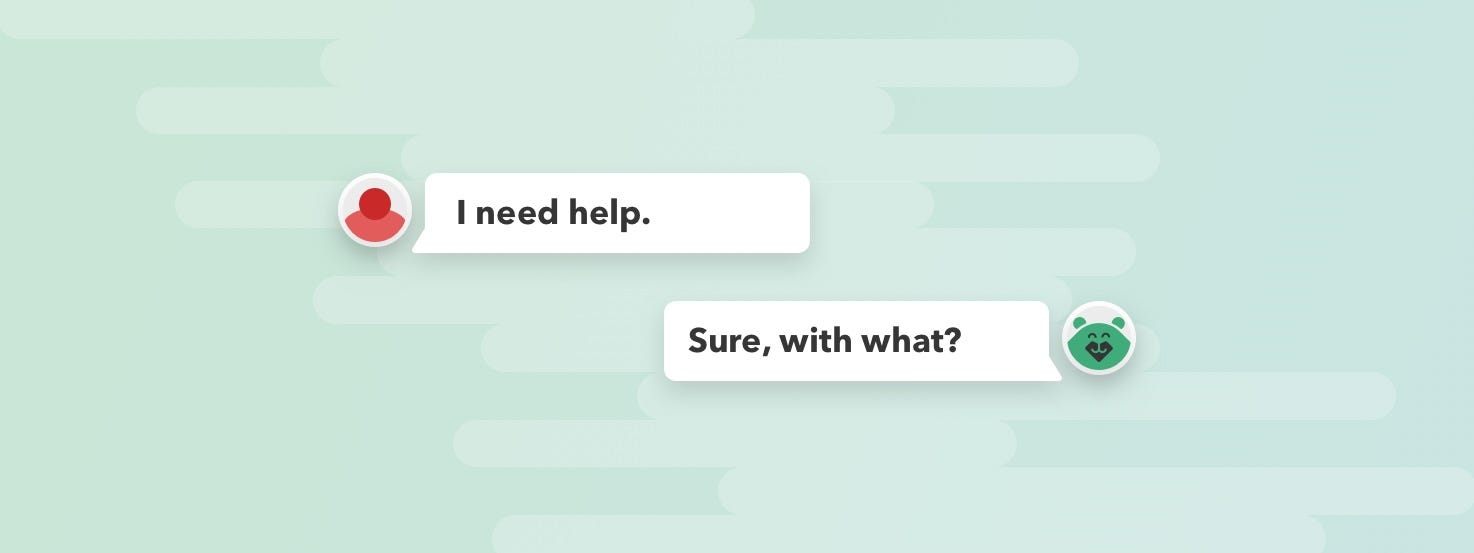
<p><strong>X:</strong> I need help.<br />
<strong>You:</strong> With what?<br />
<strong>X:</strong> With something.<br />
<strong>You:</strong> What thing?<br />
<strong>X:</strong> A thing that’s giving me problems.<br />
<strong>You:</strong> Okay.<br />
<strong>X:</strong> Can you help me?<br />
<strong>You:</strong> ¯\_(ツ)_/¯</p>

<p>How would you feel if you we were part of a similar conversation? Wouldn’t you get frustrated at the fact that you are not given sufficient information from the person who is asking you for help? I would. A conversation like this feels like pulling teeth. The person who is asked for help is also asked to do a lot of work in order to provide said help. So why do many beginner developers do the exact same thing?</p>

<p>I believe that a typical beginner programmer has no clue what kind of information they have at their disposal. When something goes wrong an avalanche of information is thrown at them and they are basically drowning in it and cannot parse out what is valuable and important from what is just noise. When you’re new to something, everything is foreign and you have no idea how to establish a hierarchy of importance when it comes to the data you’re given. A person learning how to be a developer is no different. The output of an error or program is a wave of information that hits the developer straight in the face. So to them, all they know is that something didn’t work and they need help figuring it out.</p>

<p>As a mentor, you want to help a beginner programmer learn and progress while helping them debug their code. To do that, you want to lead them towards an answer and not give it to them without explaining how you got there. A lot of the times this process takes place over chat (like on Slack), but the same thing applies in person as well. Here’s the equivalent of the above conversation but about code:</p>

<p><strong>X:</strong> I’ve got an error I can’t figure out.<br />
<strong>Me:</strong> Okay.<br />
… *wait to see if X is typing up some more info*<br />
… *5 minutes later*<br />
<strong>Me:</strong> What’s the error?<br />
<strong>X:</strong> <code class="language-plaintext highlighter-rouge">undefined method</code><br />
<strong>Me:</strong> What’s the undefined method?<br />
<strong>X:</strong> <code class="language-plaintext highlighter-rouge">undefined method '[]'</code><br />
<strong>Me:</strong> Can you copy/paste for me the whole error and everything relevant to it? I can better assist you if I’m not flying blind and I need to see the whole output of the command line and the relevant piece of code.<br />
<strong>X:</strong> sure thing, one sec…<br />
*X typing…*<br />
*is X typing the whole error from the command line letter by letter instead of copy/pasting?<br />
*X pastes a bunch of stuff then deletes it*<br />
*okay, maybe X is trying to format it in a legible way and is trying to figure out how this ``` thing works in Slack*</p>

<p><strong>Quick interjection:</strong> There are a lot of tools out there that a beginner programmer needs to get familiar with, and although most people are used to chat apps, formatting code within those apps is not a familiar thing. So here’s a what otherwise would be a simple thing stomping them because they still have not yet mastered this part of communicating via chat, while trying to understand an error. And when you already feel like you’re drowning, a single additional drop could feel like an ocean. At this point, depending on how evil I feel, I either suggest we hop on a call and share screens or let them struggle hoping it’s a learning opportunity for them to get better at communicating via chat. I’m mostly evil and watch this thing unfold slowly, but also make sure to compensate this with times where I make it easier on the person because I want to strike a balance and not make the experience insufferable. Now back to the original plot…</p>

<p>*a few moments later…*<br />
<strong>X:</strong></p>

<pre><code class="language-output">undefined method `[]’ for nil:NilClass on 
features/step_definitions/foo_steps.rb:28
</code></pre>

<p>*wait a couple of minutes longer*<br />
<strong>Me:</strong> You know Slack doesn’t charge us a tax on the number of works or messages we send right?<br />
You don’t have to be stingy with the code you share with me. You can paste all of it here, Slack won’t charge us extra.<br />
And I don’t read minds nor do I have a 🔮. So I need to see what you’re working on to be able to help you out.<br />
<strong>X:</strong> haha<br />
<strong>X:</strong></p>

<div class="language-ruby highlighter-rouge"><div class="highlight"><pre class="highlight"><code><span class="n">fill_in</span><span class="p">(</span><span class="err">‘</span><span class="no">First</span> <span class="no">Name</span><span class="err">’</span><span class="p">,</span> <span class="ss">with: </span><span class="vi">@user</span><span class="p">[</span><span class="ss">:first_name</span><span class="p">])</span>
</code></pre></div></div>

<p>ʕノ•ᴥ•ʔノ ︵ ┻━┻<br />
*keep your cool, they’re new to this, they don’t yet get it*<br />
<strong>Me:</strong> Okay, is there more code around the line you just sent? Does the file that you’re working on have more lines of code?<br />
<strong>X:</strong> Yes</p>

<div class="language-ruby highlighter-rouge"><div class="highlight"><pre class="highlight"><code><span class="k">def</span> <span class="nf">new_user</span>
 <span class="vi">@user</span> <span class="o">=</span> <span class="p">{</span> <span class="ss">first_name: </span><span class="err">‘</span><span class="no">First</span><span class="err">’</span><span class="p">,</span> <span class="ss">last_name: </span><span class="err">‘</span><span class="no">Last</span><span class="err">’</span> <span class="p">}</span>
<span class="k">end</span>
</code></pre></div></div>

<div class="language-ruby highlighter-rouge"><div class="highlight"><pre class="highlight"><code><span class="no">Given</span> <span class="err">…</span> <span class="k">do</span>
 <span class="n">fill_in</span><span class="p">(</span><span class="err">‘</span><span class="no">First</span> <span class="no">Name</span><span class="err">’</span><span class="p">,</span> <span class="ss">with: </span><span class="vi">@user</span><span class="p">[</span><span class="ss">:first_name</span><span class="p">])</span>
 <span class="n">fill_in</span><span class="p">(</span><span class="err">‘</span><span class="no">Last</span> <span class="no">Name</span><span class="err">’</span><span class="p">,</span> <span class="ss">with: </span><span class="vi">@user</span><span class="p">[</span><span class="ss">:last_name</span><span class="p">])</span>
<span class="k">end</span>
</code></pre></div></div>

<pre><code class="language-output">...
</code></pre>

<p><strong>Me:</strong> Finally. Now we’re talking.</p>

<p>You, the reader, may think I’m exaggerating, I am not. This 👏🏽 happens 👏🏽 all 👏🏽 of 👏🏽 the 👏🏽 time 👏🏽. This is not taken out of one example with one person. This is has happened with me on multiple occasions per person, with many people of different sizes and shapes, over a decade worth of work in the industry. I know there might be a couple of people reading this right now thinking I am specifically talking about them. One of you is guilty of being the latest person to do it and where the example above is inspired by, but you are not alone 😉.</p>

<p>Because this scenario has happened multiple times, I decided to write a blog post about it because I am sure this will happen to me again soon and probably to others out there. The next person I go through this with will likely get a link to this post instead of me spending half of the day going through the tedious motions (Hi! 👋🏽 Glad to be working with you, it’s going to be fun…). So here are a few tips to help you ask for help with your code from someone:</p>

<h3 id="1-chat-is-asynchronous">1. Chat is asynchronous:</h3>

<p>The beauty of chat is that it’s asynchronous. <br />
<strong>What not to do:</strong> Kill its killer feature by sending something like “Hey, can you help me with something?” or “Hey, I’m getting an error.”<br />
<strong>What to do instead:</strong> Say what you came here to say. Whoever you’re talking to will get back to you once they’ve got a minute, so make sure in that minute they have something meaningful to say other than “Sure” or “In 5 minutes” or “What’s the error?” or even worse “I did a moment ago but not right now”. Set it up so that when they see your message they have everything they need to know.</p>

<h3 id="2-do-the-hard-work-yourself">2. Do the hard work yourself:</h3>

<p>Don’t make the person you’re asking help from, do more work than you. They are taking time away from what they have to do to help you out. Respect that by doing the hard work upfront.<br />
<strong>What not to do:</strong> Ask a question to someone that you can Google yourself.<br />
<strong>What to do instead:</strong> Do some research before reaching out to someone else for help. Don’t spend an entire day (or even more than 30 minutes) researching something, but as long as your search keeps coming up with new answers keep looking. The moment you hit a block is when you should reach out.</p>

<h3 id="3-read">3. Read:</h3>

<p>That’s an odd one to include, right? Well, sometimes common sense approaches are the ones most valuable to repeat and highlight.<br />
<strong>What not to do:</strong> Run a program (app, small script, tests, anything), see red in the terminal (or browser), immediately switch back to the code editor and change a bunch of stuff randomly, and try again. A few tries later you’ve deleted the code that was working, kept the broken code, and are in a messy situation.<br />
<strong>What to do instead:</strong> Read the error that’s printed on the screen. Programmers have put in a lot of work to make languages and frameworks print out helpful messages with good instructions on how to fix common errors. Do them and yourself a favor and read the output of the error. Read EVERYTHING. Start by reading the full thing, then go back and re-read every chunk at a time and try to comprehend exactly what is being communicated to you. Many times the answer is in the error report but beginners don’t bother reading the whole thing, get to the first two or three words then assume they know what’s going on. It’s amazing how beginners assume they know what’s going on when they are the most likely people to have no clue what just happened. We, humans, are hilarious in our behavior!</p>

<h3 id="4-contextmatters">4. Context matters:</h3>

<p>Be generous with the information you share upfront that sets up the context for the other person. This is the culmination of everything above. You’ve read the error carefully, you’ve done some research about what could possibly be happening, you’ve hit a roadblock, and are about to reach out for help. What you do next is what will determine the outcome and the onus is on you to do it right.<br />
<strong>What not to do:</strong> Send something like “I’ve got an error I can’t figure out.” on Slack. Before you hit enter on the first thing you send, make sure you have everything the other person needs to help you out. Treat the first message you send as the difference maker between whether you will get help or not.<br />
<strong>What to do instead:</strong> Start by sharing the context, the full context. Which usually means including the following:</p>

<ul>
  <li><strong>Intentions:</strong> what are you trying to do? In layman’s terms explain what you want to achieve. The code you’ve written might not actually coincide with your intentions, so if the person helping you doesn’t know the “why”, they’ll miss the opportunity to give you directions towards achieving your actual goals and might send you down the wrong path.</li>
  <li><strong>Your proposed solution:</strong> In a natural language (i.e. English), explain the solution you’re proposing to use to solve the problem at hand, or get to the intended goal, what you described in the intentions section.</li>
  <li><strong>The code:</strong> Share the FULL snippet (or multiple snippets, as many as necessary) of code that is relevant to the problem at hand. This is the code that supposedly implements the proposed solution you’ve described. Be generous. Don’t share one line of code, or just the minimum. In fact, share everything that you think is relevant or touches on the part of the code that is causing you to request help. It’s okay to share more than you need, an experienced developer can easily ignore the extra stuff, but none of us have crystal balls and can read minds (contrary to popular belief), so no one would be able to guess code they are not aware exists. Make sure to use proper formatting when sharing, either by using the ``` code block if using Slack or uploading a snippet with the appropriate language setting so that syntax highlighting can make it easier for others to read what you’re sharing. If you’re sharing snippets from a class, indicate that by either copying the full class or at least the class definition (`class Foo … end`) and using <code class="language-plaintext highlighter-rouge">…</code> for the omitted parts. If the code that you’re dealing with spans multiple files indicate that as well.</li>
  <li><strong>The output:</strong> If there’s an error that you want help with, share the full error message and the full stack trace, leaving nothing behind. If the output you’re dealing with is the output of a test run, share the full output and highlight any colors that the terminal might be showing you (so for example, a passing test that is in green, pending in yellow, failing in red need to be all specified) so that the person reading can tell what part needs attention. In situations like this sharing a screenshot of the output might be easier, but if you do that also share a text copy of it, the other person helping out might want to copy/paste a code block and screenshots mean that they’d have to manually type something up and that’s just a pain and added work you’re asking of them.</li>
  <li><strong>Your interpretation of the output:</strong> If you are getting mentored by someone, the important part of the process is for you to learn how to help yourself out in the future when faced with similar situations. For that to work, you need to learn how the more experienced person, the mentor, is solving the problem. Which means that the important piece of the discussion is not the answer, but how to get to the answer. So share what you think is happening so that the mentor can assess whether you’re on the right track or not and if not explain to you what their interpretation is and help lead you towards the fix.</li>
  <li><strong>Your research:</strong> Let your mentor know what you’ve tried so far to deal with the situation. It helps avoid going down paths you’ve already tried. It also helps identify an area where you might have been on the right track but missed the aha moment or the key part that would have solved the issue for you. Situations like these are nice because they let the mentor nudge you in the right direction but also show you that you were almost there and just needed one tiny piece to the puzzle and you would have gotten it yourself. So it can feel like a small victory and progress, which is a great thing.</li>
</ul>

<p>In summary, when asking for help from someone else do not make them do the hard work for you, do the initial work yourself. Share the snippets of code, the output, and everything that can help identify what the issue is. Without this information, you’re asking the person doing you a favor to put in a lot of effort just so that they can tell you that you had a typo. Don’t do that, that’s not nice!</p>]]></content><author><name></name></author><category term="mentorship" /><category term="learning-to-code" /><category term="mentorship" /><summary type="html"><![CDATA[X: I need help. You: With what? X: With something. You: What thing? X: A thing that’s giving me problems. You: Okay. X: Can you help me? You: ¯\_(ツ)_/¯]]></summary><media:thumbnail xmlns:media="http://search.yahoo.com/mrss/" url="https://bearandgiraffe.com/assets/images/blog/beginners-guide-to-asking-for-help/1.jpg" /><media:content medium="image" url="https://bearandgiraffe.com/assets/images/blog/beginners-guide-to-asking-for-help/1.jpg" xmlns:media="http://search.yahoo.com/mrss/" /></entry><entry><title type="html">Things to know as a new dev</title><link href="https://bearandgiraffe.com/blog/things-to-know-as-a-new-dev/" rel="alternate" type="text/html" title="Things to know as a new dev" /><published>2018-01-29T17:01:02+00:00</published><updated>2018-01-29T17:01:02+00:00</updated><id>https://bearandgiraffe.com/blog/things-to-know-as-a-new-dev</id><content type="html" xml:base="https://bearandgiraffe.com/blog/things-to-know-as-a-new-dev/"><![CDATA[<figure>
  <img src="/assets/images/blog/things-to-know-as-a-new-dev/1.jpg" alt="" width="1920" height="1080" loading="lazy" />
</figure>

<p>I love meeting new devs who are making the transition from a different career into tech. I am mostly excited to see all these minds coming together to give tech a perspective that is rooted in real world experiences that most CS grads don’t go through. Many of them ask me a bunch of questions about what they need to do to make it in the field, and although I enjoy talking to each person individually and giving them my perspective in a personalized matter, I think it’s beneficial to share some of the common questions and answers with a wider community.</p>

<p>Not only that, I shared the list of questions in a bunch of Slack channels and on twitter and collected a few responses from other devs in the field. I think the responses are a great collection of diverse wisdom and I’m excited to share it with you here.</p>

<p>Here are the questions and a summary of the answers:</p>

<h2 id="1-what-are-the-most-important-skills-a-new-developer-should-have-going-into-an-interview-or-new-job-at-anycompany">1. What are the most important skills a new developer should have going into an interview or new job at any company?</h2>

<p>As a new developer, the technical expectations aren’t high. If you’ve gone through a 12 week intensive program, there is no way you’ve picked all of the technical knowledge you require to do the job and have become an expert in them. Which is why the things good interviewers will be looking for tend to be the following: <strong>critical thinking, communication (writing, speaking), organization, ability to do hard work, humility, strong interpersonal skills, ability to learn/adapt and apply new knowledge, and attention to detail</strong>.</p>

<p>Many would argue, myself included, that those skills are not only important for new developers trying to get their first job, but for any person doing any job, regardless of their experience level.</p>

<p>Honorable mentions: having side projects and a public profile help. The ability to explain solutions you’ve implemented or talking through a problem during an interview can give the interviewer some insight into your way of thinking and how you would deal with a situation that might arise at the job.</p>

<h2 id="2-how-do-i-keep-fresh-on-material-while-i-jobhunt">2. How do I keep “fresh” on material while I job hunt?</h2>

<p>This question got some interesting answers, and I believe that the intention behind it might have been misunderstood because of the word “fresh”, which is why I surrounded it by quotation marks here, even though it wasn’t in the original survey.</p>

<p>The original intent of the person who asked this question was not to ask how to learn the “freshest” new framework or language or tool, but actually how to keep the things that were learned during the program without risking losing that knowledge while job hunting. The truth of the matter is that it will take many months for a code school graduate to find a job. Some have gone 6 to 9 months before they were able to land their first job. Many have had to wait longer. Some end up taking jobs in tech but that are not programming jobs. Any knowledge acquired that is not put to practice is at risk of being lost.</p>

<p>Then, to rephrase the question, what are things that can be done to continue practicing the things that were learned in the program, in order to avoid the risk of losing that knowledge?</p>

<p>To that effect, the relevant answers were along the lines of: establish a <strong>habit or a routine to do coding exercises</strong> on a regular basis. <strong>Use sites like</strong> <a href="http://www.codewars.com/"><strong>www.codewars.com</strong></a> <strong>or</strong> <a href="http://exercism.io"><strong>http://exercism.io</strong></a> <strong>to practice.</strong> Find a group and meet with them on a regular basis to help each other out, just like a <strong>study group</strong> in school/college. Join your local <strong>meetups</strong>, most will probably have a Slack channel that you can join and ask questions on. Subscribe to <strong>blogs/screencasts/podcasts or hacker news/reddit</strong> (if you have a list of good resources, please share in the comments, I recommend <a href="https://www.rubytapas.com">https://www.rubytapas.com</a>). Participate in <strong>hackathons</strong>, don’t be intimidated to join a random hackathon group to work on a small project, you can look for your local or nearest Hack4Change group and volunteer over a weekend to work an idea for civic change. And I kept this for last because it will shock you how simple yet important this answer is: <strong>read a book</strong>! Most, if not all technical books have code examples that you can follow along with. Set a schedule for yourself as if you were at an actual 9–5 job, and follow along a book and do the code part yourself. That’s how I personally learned Rails, by following through the <a href="https://pragprog.com/book/rails4/agile-web-development-with-rails-4">Agile Web Development with Rails</a> from <a href="https://pragprog.com">PragProg</a>.</p>

<p><strong>Caveat:</strong> Don’t try to do everything at once. When it comes to learning, focus is important. Be very disciplined with your learning and don’t try to do too much. Or else you’ll end up doing a lot but not learning much.</p>

<h2 id="3-how-do-i-stand-out-from-the-others-in-an-interview-or-when-looking-for-freelance-work">3. How do I stand out from the others in an interview or when looking for freelance work?</h2>

<p>This one is tough and the answers were very interesting and diverse. Which is why I will copy most answers as is, because unlike the previous questions, there wasn’t one overarching theme to the answers.</p>

<ul>
  <li>Build a portfolio of stuff you’ve worked on. Be active in your community (i.e. Contribute to open source if possible, blog, attend and speak at local meetups in your area).</li>
  <li>Standing out is easy. Standing out in a positive way may prove to be a little harder. Find some unique selling point about yourself that you honestly believe makes you a better choice than other candidates.</li>
  <li>Realize that you don’t [know] anything, but are eager to learn</li>
  <li>Knowledge of the company and interest in what they do</li>
  <li>Specialize in one thing and be familiar with lots of things</li>
  <li>Be aggressive. A — type personality</li>
  <li>Show the projects you’ve worked on, talk about your journey to becoming a dev</li>
  <li>As a small business owner, the people who stand out in interviews are the ones who did other stuff around the interview, they followed up, they asked good questions, they were curious about the work place and our clients. When looking for freelancers, I want some self sufficient, with a go-getter attitude, they’re being depending on to do the job and do it sell.</li>
  <li>Take the time to craft your cover letter, or the Goal section of your resume, specifically to target each opportunity you interview for. Demonstrate genuine interest in what that company does, or at least something about its industry. It always helps to be able to say in the interview, “I’m really happy to be able to talk to your company specifically because ____”</li>
  <li>Honestly, I don’t understand how people judge these things.</li>
</ul>

<p>My 2 cents: Stand out as a person, each one of us is unique, our journey is unique. Share parts of that story if you are comfortable, show the person you’re talking to that they’d want to work with you. Everything else, the technical part, will take care of itself in due time. Especially those of you who are making a transition from a different career path, you’ve got skills and knowledge that will make you stand out, don’t underestimate their relevance. For example, if you are a baker, you understand following precise instructions, and that’s what programming is. We are all walking around with a bag of tricks, figure out which ones are relevant and make them work for your advantage.</p>

<h2 id="4-what-is-the-best-way-and-places-tonetwork">4. What is the best way and places to network?</h2>

<p>The answer was unanimous: <strong>meetups</strong>. “80% of success is just showing up” is a quote from one of the answers, which reminded me of something one of the local meetups’ organizers said once:</p>

<blockquote>
  <p>If you show up to a meetup once, you’re part of the top 80 percentile of the community. If you show up on a regular basis, you’re part of the top 99 percentile.</p>
</blockquote>

<p>One thing worth mentioning that was brought up in a couple of the answers is to network in diverse communities, not just tech related ones. You never know who may connect you with the person that will eventually hire you, could be on a hike, at a mountain climbing event, or at a soap making workshop. The key is to put yourself out there and meet as many people as possible.</p>

<p><strong>Austin Bonus:</strong> If you are in the Austin area, a few tech related meetups to check out are: <a href="https://www.meetup.com/Austin-on-Rails/">Austin on Rails</a>, <a href="https://www.meetup.com/austinrb/">AustinRB</a>, <a href="http://www.refreshaustin.org">Refresh Austin</a>, <a href="https://www.meetup.com/Women-Who-Code-Austin/">Women Who Code</a>, <a href="https://www.girldevelopit.com/chapters/austin">Girl Develop It</a>, and <a href="https://twitter.com/cafebedouins">Cafe Bedouins</a> (although not as active anymore, really all you need is to broadcast to the group that you’d be working out of a cafe at a particular date and time, and people will join you).</p>

<h2 id="5-should-i-apply-for-a-job-that-is-above-my-skill-level-or-has-requirements-in-programming-languagesframeworks-that-i-do-notknow">5. Should I apply for a job that is above my skill level, or has requirements in programming languages/frameworks that I do not know?</h2>

<p>I remember in 2008 seeing job posting that included the following line: “10+ years of experience with Ruby on Rails”. Rails came out in 2005, so not even DHH had 10 years of experience at that time.</p>

<p>This kind of stuff still happens all of the time. So <strong>YES</strong>, do apply to jobs that might have requirements you don’t meet. But be reasonable. Don’t reach for things you know you can’t do, or learn how to do. If they ask for experience in Angular, but you’ve only done React, you do have the skills needed to make the transition. But if you’ve only worked with JS and the job is asking for a Sr. C developer, that would be a stretch. Challenge yourself, but also make an educated guess. Know the situation, and don’t put yourself in a position to embarrass yourself, but also don’t be afraid to push yourself. As they say: Don’t dress for the job you have, dress for the job you want to have.</p>

<h2 id="6-what-are-the-best-sites-for-open-source-projects-at-anylevel">6. What are the best sites for open source projects at any level?</h2>

<p>I knew that for this question there was going to be one person with THE best written and formulated answer, and the web didn’t disappoint. Which is why I’ll copy it verbatim here:</p>

<blockquote>
  <p><a href="http://www.firsttimersonly.com">http://www.firsttimersonly.com</a> is a good place to get started. Another approach is to find a project that you find interesting and write documentation for things that weren’t clear for you in trying to use it, write examples using the project, and write tests for areas that aren’t covered. Then, start with small issues, like logging or error message improvements, before moving on to bigger bug fixes or features. Upgrading minor library dependencies is also a good place to start.</p>
</blockquote>

<p>That said, I was waiting for a response from a particular someone. This person has given <a href="https://www.schneems.com/2016/05/31/saving-sprockets.html">talks</a> about this issue, and even created a platform to help people contribute to OSS. The person I’m talking about is non other than Richard Schneeman who is behind <a href="https://www.codetriage.com">https://www.codetriage.com</a>. Hey Schneems, got anything you’d like to add to this answer?</p>

<p>I hope this helps anyone who is just starting in tech. One more thing I would add: reach out to someone you admire in the community and ask them if they would be your <strong>mentor</strong>. If they say no, ask someone else. I guarantee you that you’d get a yes within the first 3 people you ask.</p>

<p>If you’ve got questions you’d like to add, don’t hesitate to post in the comments.</p>

<p>If you’ve got more suggestions to the answers above, please do share!</p>]]></content><author><name></name></author><category term="mentorship" /><category term="mentorship" /><category term="career" /><summary type="html"><![CDATA[I love meeting new devs who are making the transition from a different career into tech. I am mostly excited to see all these minds coming together to…]]></summary><media:thumbnail xmlns:media="http://search.yahoo.com/mrss/" url="https://bearandgiraffe.com/assets/images/blog/things-to-know-as-a-new-dev/1.jpg" /><media:content medium="image" url="https://bearandgiraffe.com/assets/images/blog/things-to-know-as-a-new-dev/1.jpg" xmlns:media="http://search.yahoo.com/mrss/" /></entry><entry><title type="html">Proud Bear</title><link href="https://bearandgiraffe.com/blog/proud-bear/" rel="alternate" type="text/html" title="Proud Bear" /><published>2017-09-12T16:01:13+00:00</published><updated>2017-09-12T16:01:13+00:00</updated><id>https://bearandgiraffe.com/blog/proud-bear</id><content type="html" xml:base="https://bearandgiraffe.com/blog/proud-bear/"><![CDATA[<figure>
  <img src="/assets/images/blog/proud-bear/1.jpg" alt="source: https://www.hakaimagazine.com/news/polar-bears-and-people-cataloging-conflict/" width="2500" height="1202" loading="lazy" />
  <figcaption>source: <a href="https://www.hakaimagazine.com/news/polar-bears-and-people-cataloging-conflict/">https://www.hakaimagazine.com/news/polar-bears-and-people-cataloging-conflict/</a></figcaption>
</figure>

<p>One of Bear &amp; Giraffe’s missions is to provide an opportunity for those who wouldn’t otherwise get one. The background story behind this goes back to when I, Youssef, first got into the job market in the U.S., I’ve told versions of this to some people, but for the first time I will give the full version.</p>

<p>I moved to Virginia in 2004, right after high school. I am a U.S. citizen but grew up overseas and went to school overseas, so I thought I wouldn’t have a problem getting a job because I am a citizen and won’t have to go through the legal bullshit some folks go through as legal residents or students trying to work in the U.S.. My aunt, whom I was living with, took me to a few places to apply for a job, places I could get to easily since I didn’t have a car or any other form of transportation. Some of these places were stores like Giants. You wouldn’t think it would be hard for me to get a job at Giants bagging groceries, right? All these places had tests that they make you take, which were weird to me because they didn’t seem related at all to the kind of job you would be doing. Yet, I didn’t hear back from any of these places.</p>

<p>One particular situation was very weird. I was applying for a job at Marshalls and they had me take the same kind of test as the rest, but this one was in paper format as opposed to the computerized one. The manager took my answers, scanned them, came back to me saying there was something wrong with my answers, so he had me take it again. Same thing happened again. He asked me if I spoke any other languages, and I told him that I spoke Arabic and French, so he gave me the same test in French. Same thing happened, yet again. Then he had one of the employees give me the test by reading the questions to me and having me answer them orally. The whole situation was creepy. The questions were stupid, things like: If a customer wants to buy items for $12.45 and gave you a $20 bill, how much change do you have to give them back? As a math major in high school and an engineering major in college, there was no way I was messing up the math, in 4 tries, I had a 710/800 SAT score on the math section. Suffice it to say, I didn’t get that job. I never thought much of these situations, I was barely 18, new culture, new everything. Who knows why I didn’t get job.</p>

<p>During my 3rd year in college, I was looking for an internship, something in the field of my major which was Computer Engineering, and something that would allow me to use my work for the 4th year thesis we were required to write. I applied to many places, and again, didn’t hear back from any of them. If you had asked my peers in the program whether or not I qualified, many would say that I was at least as good as they are, if not better. Yet many of my peers got multiple offers, I got none. It took a family member to use their connection with the CEO of their company to get me into an internship program. I, of course, heard about how I wasn’t supposedly “good enough” from the manager who hired me, but that I got the job as a request from the CEO. I can venture to say that out of 3 of us interns who were in the same position, I was as productive if not more than the other 2.</p>

<p>Same thing happened during 4th year, when I was applying for a full time job. I had one of the smartest professors in the Computer Science department pretty much beg me to stay in the program and do a PhD with him because he wanted people like me in the program. Yet I got 2 interviews out of all of the applications I submitted. At the first one, the person who scheduled the interview did not show up and hadn’t notified his coworkers about the interview. So the 2 hour drive (each way) was all for nothing, and he didn’t even bother to reschedule. Which means that really I only had 1 interview, and ended up getting that job.</p>

<p>When all of this was happening, I didn’t make anything of it. But then, years later, I kept on reading stories about how women in tech were dealing with sexism and being passed for opportunities they were qualified for. These stories got me doing an introspective about what kind of privilege I was benefiting from as a male. I still hadn’t even thought much about the stories of my past, until one person asked me if I had ever suffered from racism, you know, being from an Arab country. I had to pause for a moment when I heard that question because I hadn’t even thought about it much in terms of work related issues. Discrimination was the normal scenario in my life because my name is Youssef. Everywhere I went I was treated differently, no matter what situation I was in. But I never put it in perspective in relation to work. That changed after reading the stories about women and black people dealing with issues, especially stories that detailed how just the name on the resume was enough to make a difference. Those accounts made me think about all of the times I might have been passed up because of my name. So the moment that question was asked, I started running through all of the stories I just briefly described.</p>

<p>But I am not telling this story in order to talk about all of the opportunities I did not get, I actually want to highlight those who did give me an opportunity. The first to do so were Michelle and Rodney, managers of the campus bookstore at NoVA Community College, they gave me my first U.S. job. They also promoted me to Shipping and Receiving Supervisor within weeks of me starting. The second group of people to give me a shot when I was very green were the folks from OpenSource Connections. I remember vividly the moment Eric and Jason from OSC threw out my CV and asked me to go on a walk around the UVA football stadium and just chat.</p>

<p>I was only given a couple of opportunities by people who knew nothing about me, and gave me a shot based on faith and a few conversations. Because of the acts of those few people, I am in the position I am today where I run my own company and consult with many clients. It is also why I am paying it forward to others. Which brings us back to the original point I started with, I always try to position B&amp;G in such a place where I can give an opportunity to others.</p>

<p>I am very intentional about how I go about it. I look for women who are either recent bootcamp graduates or mothers who are getting back into the field after taking time off to take care of their kids. The way I understand the market is that someone in that position is very likely to be dismissed from potential jobs based solely on their sex, and sometimes based on their lack of experience. On the flip side I get clients who want me to help them out with small projects that are too small to be worth my time as opposed to the longer/higher paying projects. Those projects are usually prime to be done by someone who is not very experienced because they are usually not very complex and short term.</p>

<p>The format is simple, hire someone to do a job, pay them, let them gain the experience working on a “real world” project, and provide mentorship along the way and guidance just like if it were a regular situation with a team in a big company. It’s not easy to manage that and juggle the time it requires to manage a project with a Jr. Developer, with the mentorship part, along with other full time commitments. It is, however, very much worth it.</p>

<p>So far, I have done this format with 3 women. 2 of them have gotten and accepted jobs after working with me. The third one has gotten offers and interviews even though she was not actively looking (what she decides to do is still to be determined). Each time I heard from one of them about the opportunities they got after our brief time working together I got super excited. I am excited for them, and proud of them. This kind of result is exactly why I do it, and I couldn’t be happier.</p>

<p>Actually, I potentially could. I could be happier if I were the one hiring these awesome women to work with me on a full time basis. And I would, if I could afford it. I would if I had a sustained funnel of projects and clients that would support one or two full time employees. That is something I am working hard on establishing, and if you are a business that is looking for a company to help you build your product, and you care about hiring a company like B&amp;G, do reach out. Until then, I will continue to try to find new people for whom I can open doors (especially people of color and women), so if you are one of those people also reach out to me. If a cold email or cold call is too awkward for you, come find me at one of the local meetups like <a href="http://austinrb.org">AustinRB</a>, <a href="http://austinonrails.org">Austin on Rails</a>, or <a href="http://www.refreshaustin.org">Refresh Austin</a> and say hi. I promise I don’t bite, or scratch, even though I am nicknamed a bear 🐻.</p>]]></content><author><name></name></author><category term="mentorship" /><category term="mentorship" /><category term="women-in-tech" /><summary type="html"><![CDATA[One of Bear & Giraffe’s missions is to provide an opportunity for those who wouldn’t otherwise get one. The background story behind this goes back to when…]]></summary><media:thumbnail xmlns:media="http://search.yahoo.com/mrss/" url="https://bearandgiraffe.com/assets/images/blog/proud-bear/1.jpg" /><media:content medium="image" url="https://bearandgiraffe.com/assets/images/blog/proud-bear/1.jpg" xmlns:media="http://search.yahoo.com/mrss/" /></entry><entry><title type="html">Typing as a Last Resort</title><link href="https://bearandgiraffe.com/blog/typing-as-a-last-resort/" rel="alternate" type="text/html" title="Typing as a Last Resort" /><published>2017-03-13T16:02:01+00:00</published><updated>2017-03-13T16:02:01+00:00</updated><id>https://bearandgiraffe.com/blog/typing-as-a-last-resort</id><content type="html" xml:base="https://bearandgiraffe.com/blog/typing-as-a-last-resort/"><![CDATA[<p>Part of the culture of B&amp;G is mentoring people new to software development, and it always takes me back to my days in college when nothing made sense or clicked like it should have. I could see it then in me and my friends, and I could see it in the students I was helping out as a TA. It took lots of practice for me to stop blindly using things the professors mentioned in class, and actually start reaching in my toolbox for the right tool based on real understanding of the problem and solution.</p>

<p>This process is not unique to me or to software development. There’s been a lot of talk about Malcolm Gladwell’s 10,000 hours rule, and deliberate practice. There are also a bunch of books that address the journey from novice to master. The journey takes time, and lots of struggling with little things, until eventually things start to click.</p>

<p>Although I cannot speed up that process for you, what I can do is provide a tip that I hope you follow in your journey from novice to master. The tip itself is simple: <strong>Reach for the keyboard last</strong>. In other words, when presented with a coding problem, the code is the last thing you should think about. Code is the byproduct of the solution, not the actual solution itself. That might be a bit counterintuitive, especially if your task is to write software, and you will struggle with following this rule, but with enough practice and being mindful about this step, it will become easier to follow as you progress in your career.</p>

<p>To illustrate this idea, let’s take a look at it in action. We’ll try to solve one of the code katas provided by <a href="http://codewars.com">http://codewars.com</a>, which presents the following challenge:</p>

<div class="language-plaintext highlighter-rouge"><div class="highlight"><pre class="highlight"><code>Some numbers have funny properties. For example:
</code></pre></div></div>

<div class="language-plaintext highlighter-rouge"><div class="highlight"><pre class="highlight"><code>89 --&gt; 8¹ + 9² = 89 * 1
</code></pre></div></div>

<div class="language-plaintext highlighter-rouge"><div class="highlight"><pre class="highlight"><code>695 --&gt; 6² + 9³ + 5⁴= 1390 = 695 * 2
</code></pre></div></div>

<div class="language-plaintext highlighter-rouge"><div class="highlight"><pre class="highlight"><code>46288 --&gt; 4³ + 6⁴+ 2⁵ + 8⁶ + 8⁷ = 2360688 = 46288 * 51
Given a positive integer n written as abcd... (a, b, c, d... being digits) and a positive integer p we want to find a positive integer k, if it exists, such as the sum of the digits of n taken to the successive powers of p is equal to k * n. In other words:
</code></pre></div></div>

<div class="language-plaintext highlighter-rouge"><div class="highlight"><pre class="highlight"><code>Is there an integer k such as : (a ^ p + b ^ (p+1) + c ^(p+2) + d ^ (p+3) + ...) = n * k
If it is the case we will return k, if not return -1.
</code></pre></div></div>

<div class="language-plaintext highlighter-rouge"><div class="highlight"><pre class="highlight"><code>Note: n, p will always be given as strictly positive integers.
</code></pre></div></div>

<div class="language-plaintext highlighter-rouge"><div class="highlight"><pre class="highlight"><code>dig_pow(89, 1) should return 1 since 8¹ + 9² = 89 = 89 * 1
dig_pow(92, 1) should return -1 since there is no k such as 9¹ + 2² equals 92 * k
dig_pow(695, 2) should return 2 since 6² + 9³ + 5⁴= 1390 = 695 * 2
dig_pow(46288, 3) should return 51 since 4³ + 6⁴+ 2⁵ + 8⁶ + 8⁷ = 2360688 = 46288 * 51
</code></pre></div></div>

<p>If I ask you to solve this problem and you commence by pasting some code or typing in your favorite code editor, <em>you’re doing it wrong</em>. It tells me that your focus is on lines of code instead of working software. And your focus should not just be on any working software, but on software that actually solves the intended problem.</p>

<p>This code challenge is interesting because I happen to think the description of the problem is cryptic. It needs a couple of read-throughs before really grasping what is being asked of us, and what are the expectations. In a case like this, the best approach is to dissect the requirements, so let’s do that:</p>

<ol>
  <li>Given a positive integer <code class="language-plaintext highlighter-rouge">n</code> and a positive integer <code class="language-plaintext highlighter-rouge">p</code></li>
  <li>Find <code class="language-plaintext highlighter-rouge">k</code> such as <code class="language-plaintext highlighter-rouge">k * n = (a ^ p + b ^ (p + 1) + c ^ (p + 2) ...</code> where <code class="language-plaintext highlighter-rouge">a, b, and c</code> are the digits in <code class="language-plaintext highlighter-rouge">n</code></li>
  <li>Check if <code class="language-plaintext highlighter-rouge">k</code> is an integer</li>
  <li>If <code class="language-plaintext highlighter-rouge">k</code> is an integer return <code class="language-plaintext highlighter-rouge">k</code>, otherwise return <code class="language-plaintext highlighter-rouge">-1</code></li>
</ol>

<p>This should be a simpler way to explain the requirements. It takes all the words and strips them to the bare minimum while staying true to the original intent. It also structures the requirements in a chronological sense which makes it easier to then break it down into the steps that are required to get to the result. So let’s do that next, what are the steps required to complete this task?</p>

<div class="language-plaintext highlighter-rouge"><div class="highlight"><pre class="highlight"><code>step 1: take n and split it to the list of digits
step 2: go through the list of digits, one by one, d(i) where i is the index of the digit in the list starting at 0 from the left
step 3: raise d(i) to the power p + i and add it to the sum (sum += d(i) ^ (p + i))
step 4: determine the value of k such that k = sum / n
step 5: check if k is an integer
step 6: if k is an integer, return k. otherwise, return -1
</code></pre></div></div>

<p>Going from the original description to the steps description above is obvious, after the fact, but it requires an effort from someone who isn’t used to it. The thing to note is that the steps definition is still in plain english, with some mathematic notations. But up to this point, we have not discussed any code yet. <strong>That’s the key take away from this</strong>. The biggest effort a developer has to focus on is being able to take some requirements, whether well structured or not, and transform them into a set of <strong>understandable</strong> and <strong>replicable</strong> steps. The final step, translating those steps into code, is the easy part. Once you know what you’re building, what comes after is just transforming the english into syntax in whichever programming language you’re using. Google is great at that ;)</p>

<p>If we wanted to transform the steps above into Ruby code, we would simply take each step and write the corresponding Ruby code. So let’s do that together:</p>

<p>Step 1: <code class="language-plaintext highlighter-rouge">digits = n.to_s.chars.map(&amp;:to_i)</code> <br />
Step 2: <code class="language-plaintext highlighter-rouge">digits.each_with_index { |d, i| }</code> <br />
Step 3: <code class="language-plaintext highlighter-rouge">sum += d ** (p + i)</code> <br />
Step 4: <code class="language-plaintext highlighter-rouge">k = sum / n</code> <br />
Step 5: <code class="language-plaintext highlighter-rouge">k % 1 == 0</code> <br />
Step 6: <code class="language-plaintext highlighter-rouge">k % 1 == 0 ? k : -1</code></p>

<p>If you’re thinking that this is too simple and too easy, well it is. It is so because we put in all the effort in the initial phase of translating the requirements into concise and understandable steps. Translating each step into code, is super easy. The only thing left to do is to put it all together:</p>

<div class="language-ruby highlighter-rouge"><div class="highlight"><pre class="highlight"><code><span class="k">def</span> <span class="nf">dig_pow</span> <span class="n">n</span><span class="p">,</span> <span class="nb">p</span>
  <span class="n">sum</span> <span class="o">=</span> <span class="mi">0</span>
  <span class="n">n</span><span class="p">.</span><span class="nf">to_s</span><span class="p">.</span><span class="nf">chars</span><span class="p">.</span><span class="nf">map</span><span class="p">(</span><span class="o">&amp;</span><span class="ss">:to_i</span><span class="p">).</span><span class="nf">each_with_index</span> <span class="p">{</span> <span class="o">|</span><span class="n">d</span><span class="p">,</span> <span class="n">i</span><span class="o">|</span> 
    <span class="n">sum</span> <span class="o">+=</span> <span class="n">d</span> <span class="o">**</span> <span class="p">(</span><span class="nb">p</span> <span class="o">+</span> <span class="n">i</span><span class="p">)</span> 
  <span class="p">}</span>
</code></pre></div></div>

<div class="language-ruby highlighter-rouge"><div class="highlight"><pre class="highlight"><code>  <span class="n">k</span> <span class="o">=</span> <span class="n">sum</span> <span class="o">/</span> <span class="n">n</span>
</code></pre></div></div>

<div class="language-ruby highlighter-rouge"><div class="highlight"><pre class="highlight"><code>  <span class="n">k</span> <span class="o">%</span> <span class="mi">1</span> <span class="o">==</span> <span class="mi">0</span> <span class="p">?</span> <span class="n">k</span> <span class="p">:</span> <span class="o">-</span><span class="mi">1</span>
<span class="k">end</span>
</code></pre></div></div>

<p>At this point, you might not have the most optimal solution but you do have a correct one. You can refactor at this stage, assuming you’ve written tests to verify that your refactoring isn’t breaking the solution. As long as you’ve demonstrated that you understand the problem, and know how to get to the solution, the rest is implementation detail.</p>

<p>If, on the other hand, you started tackling this challenge by typing something like:</p>

<div class="language-ruby highlighter-rouge"><div class="highlight"><pre class="highlight"><code><span class="k">def</span> <span class="nf">dig_pow</span> <span class="n">n</span><span class="p">,</span> <span class="nb">p</span>
  <span class="p">(</span><span class="mi">1</span><span class="o">..</span><span class="nb">p</span><span class="p">).</span><span class="nf">each</span> <span class="k">do</span>
    <span class="o">...</span>  
  <span class="k">end</span>
<span class="k">end</span>
</code></pre></div></div>

<p>or</p>

<div class="language-ruby highlighter-rouge"><div class="highlight"><pre class="highlight"><code><span class="k">def</span> <span class="nf">dig_pow</span> <span class="n">n</span><span class="p">,</span> <span class="nb">p</span>
  <span class="n">n</span> <span class="o">&gt;=</span> <span class="mi">0</span> <span class="o">&amp;&amp;</span> <span class="nb">p</span> <span class="o">&gt;=</span> <span class="mi">0</span>
  <span class="n">k</span> <span class="o">=</span> <span class="n">n</span><span class="o">**</span><span class="nb">p</span> <span class="o">+</span> <span class="n">n</span><span class="o">**</span><span class="p">(</span><span class="nb">p</span><span class="o">+</span><span class="mi">1</span><span class="p">)</span> <span class="o">+</span> <span class="n">n</span><span class="o">**</span><span class="p">(</span><span class="nb">p</span><span class="o">+</span><span class="mi">2</span><span class="p">)</span>
<span class="k">end</span>
</code></pre></div></div>

<p>That indicates to me that you are just guessing, you took a handful of spaghetti, threw it at the wall, and are hoping something sticks, without fully understanding what’s actually required and how to achieve. Yet, many developers start that way. I’ve done it too. We all have. We start by assuming we understand the problem and we start typing code thinking that the code will lead us to the solution. When in fact, typing should be the last thing we do in the process. Thinking being the first. Analyzing the second. Strategizing the third…</p>

<p>This was an example that might feel useless to you for all intents and purposes. To me, this example highlights a key issue with software development, which is the skill of understanding business requirements and the needs of the user before attempting to write any line of code. So if you practice what we’ve discussed in this post with every coding challenge or task you’re presented with, you are setting yourself up for success when it comes to acquiring requirements from a client or a product owner.</p>

<p>I hope this helps and makes your journey on your way to mastery less painful :)</p>]]></content><author><name></name></author><category term="mentorship" /><category term="ruby" /><category term="career" /><summary type="html"><![CDATA[Part of the culture of B&G is mentoring people new to software development, and it always takes me back to my days in college when nothing made sense or…]]></summary></entry><entry><title type="html">The Finish Line is Closer Than You Think</title><link href="https://bearandgiraffe.com/blog/the-finish-line-is-closer-than-you-think/" rel="alternate" type="text/html" title="The Finish Line is Closer Than You Think" /><published>2017-02-26T16:02:00+00:00</published><updated>2017-02-26T16:02:00+00:00</updated><id>https://bearandgiraffe.com/blog/the-finish-line-is-closer-than-you-think</id><content type="html" xml:base="https://bearandgiraffe.com/blog/the-finish-line-is-closer-than-you-think/"><![CDATA[<figure>
  <img src="/assets/images/blog/the-finish-line-is-closer-than-you-think/1.jpg" alt="" width="459" height="363" loading="lazy" />
</figure>

<p>Recently I was helping out a new developer with code they couldn’t get to behave properly. To someone new to programming everything is a big deal. As an experienced programmer, it’s hard to imagine how simple thing like variables can be one of the biggest challenges to newbies. The reality, though, is that we’ve been there too. We had our time when scope and variable naming was something we would spend a lot of time trying to figure out. It’s just been so long, that we don’t relate anymore.</p>

<p>In college, I was a TA for CS101. I was the TA immediately the following semester after I took the course. It sounded ridiculous at first. Imagine a 7th grader teaching a 6th grader. That would be odd, wouldn’t it? But the professor, the actual person teaching, made a very good point at the time. He said that we are the ones who would relate the best with the students, the struggle of that course is still fresh in our mind and our experience is the closest to theirs. Which is why we would be better suited to help the current students in office hours than he is because when you can relate to the problems the other person is facing you’re better equipped to help them through it.</p>

<p>That said, it’s not only important to be able to relate to the person facing the problem, it’s as important for the person you’re helping to be able to relate to you as well. It is important for someone who is struggling to know that the finish line is reachable. If the finish line is a professor with a Ph.D. when they’re still in their first semester of college, that finish line will not seem achievable and realistic. Whereas if you make it evident that the finish line is much closer, as in a peer who’s only one semester ahead, the goal will seem much more possible. The professor knew that back then, and it’s been something I’ve kept with me all this time, especially when dealing with people who are just beginning their career in development.</p>

<p>Now back to the conversation with the new developer. The mistake they made was a silly one, but a silly mistake any developer could make, regardless of experience level. So it was great to see someone else in the group chime in with: “I suspect everyone here has made this exact bug”. I was about to say the same exact thing. It just made a much bigger impact coming from someone else, at least in my opinion. It also felt natural and genuine. And I really liked that it was said. It’s important to let new developers know that the stuff they struggle with are things everyone else has struggled with at one point in their career. Writing code is something that takes a lot of time to click, and each person gets there at a different pace. It’s OK if a newcomer isn’t there yet. It will click. It just requires patience.</p>

<p>So to all the new developers out there I say: be patient, give it time, it’s OK if you are making silly mistakes at this time, and more importantly it’s definitely OK to ask about anything you are unsure of. We are not judging you, we were you at one point, and we want to help you.</p>]]></content><author><name></name></author><category term="mentorship" /><category term="learning-to-code" /><summary type="html"><![CDATA[Recently I was helping out a new developer with code they couldn’t get to behave properly. To someone new to programming everything is a big deal. As an…]]></summary><media:thumbnail xmlns:media="http://search.yahoo.com/mrss/" url="https://bearandgiraffe.com/assets/images/blog/the-finish-line-is-closer-than-you-think/1.jpg" /><media:content medium="image" url="https://bearandgiraffe.com/assets/images/blog/the-finish-line-is-closer-than-you-think/1.jpg" xmlns:media="http://search.yahoo.com/mrss/" /></entry><entry><title type="html">Mentoring</title><link href="https://bearandgiraffe.com/blog/mentoring/" rel="alternate" type="text/html" title="Mentoring" /><published>2017-01-23T16:32:02+00:00</published><updated>2017-01-23T16:32:02+00:00</updated><id>https://bearandgiraffe.com/blog/mentoring</id><content type="html" xml:base="https://bearandgiraffe.com/blog/mentoring/"><![CDATA[<figure>
  <img src="/assets/images/blog/mentoring/1.jpg" alt="" width="1500" height="750" loading="lazy" />
</figure>

<p>My self diagnosis, with no real qualifications to make one other than being me, is that I am too stubborn and take no bullshit from other which has come in the way of me being mentored by someone else. There might have been instances where someone was trying to give me advice and my nature of questioning everything blocked it from registering. My “blame it on others” excuse is that no one has wanted to be my mentor. Which ever the case may be, I have not had mentors throughout my life that I could resort to for advice and I am aware of the huge advantage and importance having one is.</p>

<p>Since moving to Austin, I have had the pleasure of meeting a lot of coding bootcamp graduates who are extremely excited to become developers and joining their local communities. Often bootcamp grads are, in a way, thrown to the wild after their cohort is over. They take an intensive course 3 to 6 months long, with some of them touching on how to land a job or do a technical interview, but otherwise that’s it. They most likely do not have career days, or on campus interviews, or any of those resources you usually would find in a 4 year college. The lucky ones get to form a good relationship with the class instructor who then serves as a reference or goto person in the future, but that depends on the instructor and their availability and willingness to continue being part of the grads’ life. So what usually happens is you get a group of people who just went through an intensive experience, looking for new jobs, and not many places that are ready for them because few tech companies have the structure and resources required to take on someone like that and make it successful. Usually, Facebook/Google/Apple/etc, companies that do have the capabilities, are too competitive for someone whose only experience is a 3 month course. A lot of these grads fall in to the vicious cycle of “you need experience to get the job, and you need the job to get the experience”, the same way I got in the cycle of “you need credit to qualify for a credit card and you need a credit card to get credit” when I first moved to the US. Someone has to step in and be the agent of change that breaks the cycle by taking a chance on bootcamp grads in some way.</p>

<p>What I have found is that regardless of how busy you are, you always have some time to try to answer someone’s question, and if you do it on a regular basis that’s all it takes to become a mentor. Which is why I have taken it upon me to be a mentor for anyone who sees any value in me being one. Usually that would be bootcamp grads who are looking for someone with experience in web development to guide them through the learning they’re doing after the course, but it could be anyone.</p>

<p>For those who are looking for Ruby or Ruby on Rails guidance, I am always available through the #help channel of the <a href="http://www.austinonrails.org/">Austin on Rails</a> team <a href="https://austinonrails.slack.com/">Slack</a> (ping me if you want to be added).</p>

<p>For those who are looking for more general dev mentoring, you can find me on the #dev-talk channel of the <a href="http://www.refreshaustin.org/">Refresh Austin</a> team <a href="http://slack.refreshaustin.org/">Slack</a>.</p>

<p>And for those who are interested in other forms of mentoring, feel free to reach out on twitter (<a href="http://twitter.com/ychaker">@ychaker</a>), or by email (<a href="mailto:mentor@bearandgiraffe.com">mentor@bearandgiraffe.com</a>).</p>

<p>Regardless of how you reach out, starting off with some questions and answers is a sure way to at least get another perspective. Taking it further to a full on mentorship type of relationship can come as a natural result of that. So do not hesitate to reach out, I am looking for something to replace TV and Facebook so I need to fill my time with something useful :)</p>

<p>On the other hand, if you happen to read this and you believe you can be a mentor to me, OMG PLEASE LET ME KNOW!</p>

<p>Before I end this, I want to send a shout out to a friend of mine named <a href="https://twitter.com/jah2488">Justin Herrick</a> who was an instructor for the Iron Yard teaching Ruby on Rails and is now taking it to the next level by providing a <a href="https://lunarcollective.co/services/team-training">service</a> for companies and startups to train their teams, which is perfect for companies who are not sure whether they should hire a Jr. Developer but want to and the reservation they have is the fact that they do not have the capability to mentor the new hire and make sure they are productive. So check out his company <a href="https://lunarcollective.co/">Lunar Collective</a> if you are interesting in hiring fresh talent!</p>]]></content><author><name></name></author><category term="mentorship" /><category term="mentorship" /><summary type="html"><![CDATA[My self diagnosis, with no real qualifications to make one other than being me, is that I am too stubborn and take no bullshit from other which has come…]]></summary><media:thumbnail xmlns:media="http://search.yahoo.com/mrss/" url="https://bearandgiraffe.com/assets/images/blog/mentoring/1.jpg" /><media:content medium="image" url="https://bearandgiraffe.com/assets/images/blog/mentoring/1.jpg" xmlns:media="http://search.yahoo.com/mrss/" /></entry></feed>