<?xml version="1.0" encoding="utf-8"?><feed xmlns="http://www.w3.org/2005/Atom" ><generator uri="https://jekyllrb.com/" version="4.4.1">Jekyll</generator><link href="https://bearandgiraffe.com/feed/business.xml" rel="self" type="application/atom+xml" /><link href="https://bearandgiraffe.com/" rel="alternate" type="text/html" /><updated>2026-11-21T19:39:02+00:00</updated><id>https://bearandgiraffe.com/feed/business.xml</id><title type="html">Bear &amp;amp; Giraffe | Business</title><subtitle>Fractional CTO and senior engineering leadership for startups. We architect scalable systems and take products from MVP to mature infrastructure.</subtitle><entry><title type="html">Look Good w. B&amp;amp;G</title><link href="https://bearandgiraffe.com/blog/look-good-w-b-g/" rel="alternate" type="text/html" title="Look Good w. B&amp;amp;G" /><published>2019-05-01T16:01:00+00:00</published><updated>2019-05-01T16:01:00+00:00</updated><id>https://bearandgiraffe.com/blog/look-good-w-b-g</id><content type="html" xml:base="https://bearandgiraffe.com/blog/look-good-w-b-g/"><![CDATA[<figure>
  <img src="/assets/images/blog/look-good-w-b-g/1.png" alt="" width="1400" height="700" loading="lazy" />
</figure>

<p>Over the weekend I was asked why I am “critical” of developers. As someone who is obsessed with being better, doing better, and my own self-improvement, I am highly critical of myself. I strongly believe that each individual <em>should</em> aim to do better all of the time. What I see happen, though, is the opposite.</p>

<p>There are many anecdotes that highlight how software developers are guilty of not providing the best service they can, and underperforming on a consistent basis. I can tell you the story of a designer with no development experience, who was told by a dev that what she is asking for is too hard and would need weeks of development to accomplish, and so she went into the dev tools in her browser, made the changes, and sent them to the dev. I can tell you about being brought in to rescue a project to find that another dev had quoted a change to a WP site as “15 hours worth of work”, and how it took me about 2 hours to go through an unnecessarily massive chain of emails to figure out what the change was supposed to be, then 30 minutes to find that it was simply a matter of entering a single number in a text box on the backend. I can also tell you about the time a startup founder was quoted by a dev shop the amount of money they knew she would accept with a fine print that read, “Any items that falls outside of the scope would be charged $XXX/hr”, knowing fully well that the scope they quoted was only a fraction of the work, banking on the fact that she’d opt for the smaller proposal and then be able to take advantage of her once the contract is signed and the work started. I have a lot of stories of this kind. I do not keep a journal of them, because that would drive me mad, but sometimes I wish I could just name and shame.</p>

<p>I am critical of devs because I know the field is littered with incompetent, unprofessional people, who ruin the reputation of the many, many good folks out there doing a great job in an honest way. If you haven’t heard, Hertz is suing Accenture (<a href="https://twitter.com/ychaker/status/1121394581315182593">https://twitter.com/ychaker/status/1121394581315182593</a>) for what I believe is a symptom of exactly what I am most critical about. Not only does Accenture now become the poster child of what’s wrong in the tech service industry, sucking up large resources, while at the same time charging a lot more than those who are doing good work. I truly believe that B&amp;G would have been able to do a much better job than Accenture, while at the same time only charging a fraction of what they did.</p>

<p>I’ve had conversations with an unfortunate number of founders who have invested their life savings into a product only to get back something that does not work or match the requirements provided. These founders are then stuck because they do not have the money to pay someone like me to rescue their project, and do not have a working product good enough to gain them customers or funding.</p>

<p>I am critical of devs because I know what quality work looks like, and I’ve seen entirely too much horrendous work. I know what those who do terrible work charge for that work. And I know the trickle down effects that it has on the startup ecosystem. Most importantly, I am critical because I want to push myself to attain a higher standard. I want to set the standard of service to be so much higher than what is currently the norm.</p>

<p>On the flip side, if we work with you, we will do our best to make you look good. Ultimately that’s our goal. We want to make the folks we partner with look good to others or those they report to. Recently, on a call with a client, a bunch of folks were arguing about how hard to execute on something the CEO asked for would be. While that was happening a member of the B&amp;G team all but finished implementing the CEO’s request and then chimed in with “I’ll have it done in an hour.” We made our partner, who brought us into the project, look good in front of their client.</p>

<p>If you want to work with a team that will make you look good (to investors, shareholders, etc) and that will not nickel and dime you, B&amp;G may just be the right fit for you. Shoot us an <a href="mailto:hello@bearandgiraffe.com">email</a> and we’d love to talk to you.</p>]]></content><author><name></name></author><category term="business" /><category term="consulting" /><summary type="html"><![CDATA[Over the weekend I was asked why I am “critical” of developers. As someone who is obsessed with being better, doing better, and my own self-improvement, I…]]></summary><media:thumbnail xmlns:media="http://search.yahoo.com/mrss/" url="https://bearandgiraffe.com/assets/images/blog/look-good-w-b-g/1.png" /><media:content medium="image" url="https://bearandgiraffe.com/assets/images/blog/look-good-w-b-g/1.png" xmlns:media="http://search.yahoo.com/mrss/" /></entry><entry><title type="html">Fuck You Money</title><link href="https://bearandgiraffe.com/blog/fuck-you-money/" rel="alternate" type="text/html" title="Fuck You Money" /><published>2019-02-19T17:51:12+00:00</published><updated>2019-02-19T17:51:12+00:00</updated><id>https://bearandgiraffe.com/blog/fuck-you-money</id><content type="html" xml:base="https://bearandgiraffe.com/blog/fuck-you-money/"><![CDATA[<figure>
  <img src="/assets/images/blog/fuck-you-money/1.jpg" alt="The Position of Fuck You (John Goodman in The Gambler)" width="1280" height="720" loading="lazy" />
  <figcaption>The Position of Fuck You (John Goodman in The Gambler)</figcaption>
</figure>

<p>There are two financial concepts I keep going back to over and over and over again: “Passive Income” and “Fuck You Money”. Passive income is something I plan towards on a personal level towards a good retirement. Fuck You Money is a theme that comes up a lot on a professional level. Ironic given the term isn’t very “professional” some might say!</p>

<p>Fuck You Money is defined by the Urban Dictionary (everyone’s favorite dictionary. <strong>PS:</strong> I hadn’t gone to that site in ages so I was quite surprised with the new branding) as:</p>

<blockquote>
  <p>The exact amount of money <strong>required</strong> in order to tell an individual or <strong>organization</strong> to go fuck themselves without <strong>facing</strong> repercussions.</p>
</blockquote>

<p><em>link:</em> <a href="https://www.urbandictionary.com/define.php?term=fuck%20you%20money"><em>https://www.urbandictionary.com/define.php?term=fuck%20you%20money</em></a></p>

<p>Money.com has an extensive <a href="http://money.com/money/4187538/f-u-money-defined-how-much-calculator/">article</a> on it as well, and of course there’s a <a href="https://www.quora.com/What-is-fuck-you-money">Quora entry</a> for it. The basic premise is that you need to have enough money to get yourself out of messy situations. That could be a bad relationship with a lover, or a bad relationship with an employer, or any person you might have a financial dependency on.</p>

<p>Now why am I talking about Fuck You Money on the B&amp;G blog? No, I didn’t post this on the company blog by mistake. People typically talk about independence on the personal level, but very rarely talk about it on an organization level. Yet being in the service industry, and being a service agency beholden to the clients we serve and in some cases being at the mercy of those clients, Fuck You Money is very much a thing for a company like B&amp;G just like it is for any individual.</p>

<p>When B&amp;G was me + subcontractors, I could to some extent couple my own personal financial freedom with that of B&amp;G. If I needed to stop working with a client for whatever reason I only needed to take my own financial situation into consideration. Now that B&amp;G has 2 full time employees besides me (yup, I hired 2 full time employees in January of 2019, it’s been quite a month so far, more on that some other time), it’s no longer as simple. Now B&amp;G is responsible for the salaries of more than just me, and B&amp;G’s financial freedom is dependent on being able to pay those salaries without interruption.</p>

<p>Just like an individual, B&amp;G needs Fuck You Money to ensure its financial freedom. Being able to fire an abusive client without repercussions requires a big enough war chest to afford to halt a relationship with a paying contract, and potentially the cost of any legal ramifications that might come with it. In fact, it doesn’t even have to come down to an extreme situation of firing the client, but even just having the ability to stand up to a client that is crossing a line, which could potentially lead to a severed relationship, is difficult without said financial freedom.</p>

<p>The hope is that we screen our potential clients well enough to not have to deal with these kinds of situations, but the reality is that we won’t alway be successful in uncovering abusive behavior or how people will behave under stress and pressure.</p>

<p>It gets even more complicated once you factor in that the more you add people to the mix the more fragile a situation can become. What I mean by that is that the more people are part of a conversation the higher the chances are that anything that is said can hurt someone. Which means the more the B&amp;G team grows the higher the likelihood of an incident that needs to be dealt with. Which adds more pressure on me personally to make sure that I avoid bad situations at all costs, and to not put my team in a situation where they’d have to deal with abuse. Yet the moment we work with a client and are dependent on them paying us is the moment we’ve already put ourselves at risk. In other words, the moment I hired someone and the moment I assigned them a project with a client is the moment I put someone else at risk of being abused. That’s heavy. That’s a big responsibility.</p>

<p>The onus is on me to make sure that B&amp;G is successful enough to build a reserve of Fuck You Money for situations when a relationship with a client goes sideways. While at the same time to build a reputation that can withstand a situation where a client would want to ruin the B&amp;G name by retaliating and smearing us. What other myriad of repercussions am I even forgetting that we’d have to fortify ourselves against? I don’t know. What I do know is that we have a hill to climb, and if you’re a small business owner I hope you’re thinking about setting up some Fuck You Money of your own.</p>]]></content><author><name></name></author><category term="business" /><category term="finance" /><category term="entrepreneurship" /><summary type="html"><![CDATA[There are two financial concepts I keep going back to over and over and over again: “Passive Income” and “Fuck You Money”. Passive income is something I…]]></summary><media:thumbnail xmlns:media="http://search.yahoo.com/mrss/" url="https://bearandgiraffe.com/assets/images/blog/fuck-you-money/1.jpg" /><media:content medium="image" url="https://bearandgiraffe.com/assets/images/blog/fuck-you-money/1.jpg" xmlns:media="http://search.yahoo.com/mrss/" /></entry><entry><title type="html">B&amp;amp;G Gets Top Marks as a Developer on Clutch!</title><link href="https://bearandgiraffe.com/blog/b-g-gets-top-marks-as-a-developer-on-clutch/" rel="alternate" type="text/html" title="B&amp;amp;G Gets Top Marks as a Developer on Clutch!" /><published>2018-06-05T15:56:42+00:00</published><updated>2018-06-05T15:56:42+00:00</updated><id>https://bearandgiraffe.com/blog/b-g-gets-top-marks-as-a-developer-on-clutch</id><content type="html" xml:base="https://bearandgiraffe.com/blog/b-g-gets-top-marks-as-a-developer-on-clutch/"><![CDATA[<figure>
  <img src="/assets/images/blog/b-g-gets-top-marks-as-a-developer-on-clutch/1.png" alt="" width="1183" height="497" loading="lazy" />
</figure>

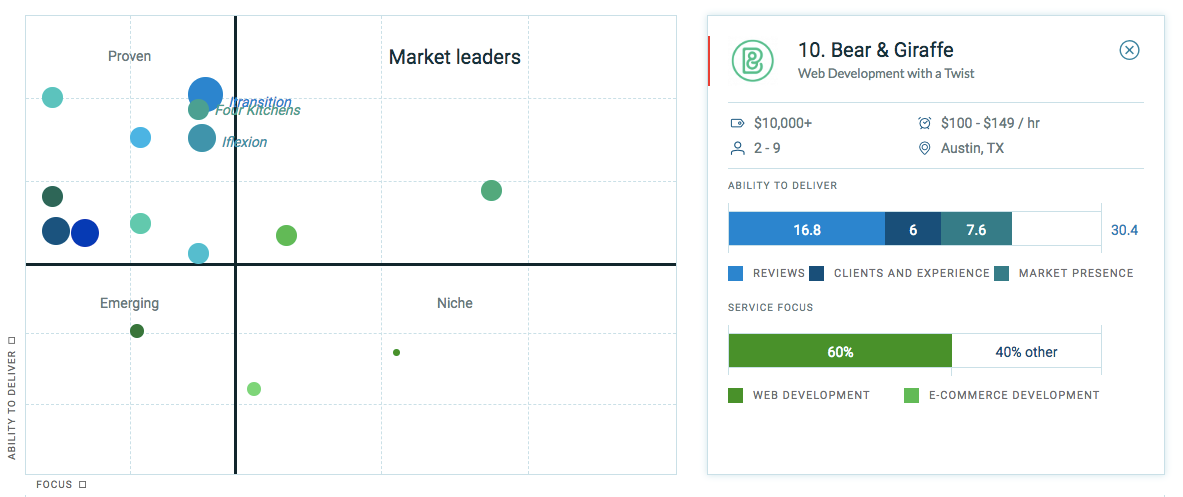
<p>Behind every great project, idea, or platform requires the proper development. Here at B&amp;G that is what we do best, and it would seem some others would agree! We are proud to announce our recent inclusion in <a href="https://clutch.co/press-releases/top-business-services-companies-austin">Clutch’s press release</a>! Clutch is a Washington, D.C. based ratings and reviews marketplace. Clutch conducts client reviews with past and current clients to obtain an accurate understanding of the type of service provided by companies.</p>

<p>Clutch performs these client reviews primarily through the medium of interview style phone calls. Clutch then compiles all of these reviews along with their ranking system to identify top industry leaders along a number of segments and locations. We have been highlighted as one<br />
of their top <a href="https://clutch.co/web-developers/austin">web developers in Austin</a>!</p>

<p>We have also been highlighted as one of the leading <a href="https://themanifest.com/web-development/companies/austin">web developers</a> on Clutch’s sister site, The Manifest. This profile of B&amp;G features our clients and an overview of our recent projects. And while we do truly dive into web development, we aren’t the kind of company to limit ourselves. We have also been identified as a leader in Ruby on Rails development!</p>

<figure>
  <img src="/assets/images/blog/b-g-gets-top-marks-as-a-developer-on-clutch/2.png" alt="" width="1480" height="1600" loading="lazy" />
</figure>

<p>One of our clients detailed their experience with our ruby on rails development by stating, “If someone is going to build something out in Rails, you want [Bear &amp; Giraffe] to do it.”, to go along with this feedback another client stated, “They really understand what’s required to build a fast product in today’s marketplace.” This understanding of the market comes in hand<br />
with being a leader along all three of these types of development.</p>

<p>We have also been very pleased with the other feedback that we have received from our clients on Clutch! One of our clients stated, “[Youssef] has a high attention to detail. He’s one of the most professional people. He’s proactive, responsive, and has the experience under his belt of how to be a really good service provider. I give nothing but top marks.” This feedback mirrors<br />
another one of our clients who stated, “We’re not Youssef’s only client, but he makes us feel that way.”</p>

<p>We strive to make each and every one of <a href="/#services">our clients</a> feel heard and special. That is our mission at B&amp;G, and we are very pleased to see that this mission has been noticed and felt by our clients. If you want to hear even more, be sure to check out our <a href="https://clutch.co/profile/bear-giraffe">full profile</a> on Clutch’s site!</p>]]></content><author><name></name></author><category term="business" /><category term="rails" /><category term="consulting" /><category term="austin" /><summary type="html"><![CDATA[Behind every great project, idea, or platform requires the proper development. Here at B&G that is what we do best, and it would seem some others would…]]></summary><media:thumbnail xmlns:media="http://search.yahoo.com/mrss/" url="https://bearandgiraffe.com/assets/images/blog/b-g-gets-top-marks-as-a-developer-on-clutch/1.png" /><media:content medium="image" url="https://bearandgiraffe.com/assets/images/blog/b-g-gets-top-marks-as-a-developer-on-clutch/1.png" xmlns:media="http://search.yahoo.com/mrss/" /></entry><entry><title type="html">Do Not Ignore the Voice of Those Who Will Suffer the Consequences of Your Decision!</title><link href="https://bearandgiraffe.com/blog/do-not-ignore-the-voice-of-those-who-will-suffer-the-consequences-of-your-decision/" rel="alternate" type="text/html" title="Do Not Ignore the Voice of Those Who Will Suffer the Consequences of Your Decision!" /><published>2017-07-25T16:01:01+00:00</published><updated>2017-07-25T16:01:01+00:00</updated><id>https://bearandgiraffe.com/blog/do-not-ignore-the-voice-of-those-who-will-suffer-the-consequences-of-your-decision</id><content type="html" xml:base="https://bearandgiraffe.com/blog/do-not-ignore-the-voice-of-those-who-will-suffer-the-consequences-of-your-decision/"><![CDATA[<p><em>DISCLAIMER: This thought has been brewing in my head for a few years. It comes from observations in workplaces I’ve been a part of and other people’s stories.</em></p>

<p><strong>PS:</strong> I will be mostly talking about web startups, but this might also be relevant for other type of companies.</p>

<p>If you are a company that’s growing, you will want to hire new people to manage the expanding scope that comes with growth. That’s typical and normal behavior. Yet, done without lots of consideration, it can be a very toxic move for the company culture. Growth is tough. Rapid growth is even tougher, and managing it can be a founder’s most important role. Growth gone wrong has affected companies in a very negative way, and has been known to contribute to demise of certain startups.</p>

<p>A silly mistake some companies do is think that a new hire that has a different title than others on the team can be vetted without the input of the other team members. What do I mean by that? For example, let’s say you are a tech startup and you feel the need to hire a product owner/manager to help translate the ideas of the founders to products and features that the tech team can develop. The mistake would be to think that the only people who need to vet the product owner hire are the founders, because the product owner will not be writing code, so the tech team does not need to vet them. That couldn’t be any farther from the truth.</p>

<p>I believe that the people who most need to vet a new hire are the people who will suffer the consequences. The consequences of hiring a new product owner will not be suffered by the founders on the same level as the developers. Why? Because who will have to actually implement any new ideas that the new product owner will come up with? Who will inherit the responsibilities and consequences of decisions made by the product owner? That’s the tech team. So although the product owner will work closely with the founders to translate their vision into wireframes, it’s the developers that will “suffer the consequences”.</p>

<p>Let’s take another example, a designer. Again, in a startup with a small group of people, you don’t have a design team and a head of design or CCO or whatever, so the founders are most likely the ones involved in the hiring process. And again, they believe that, as founders, it’s up to them to choose who to hire. They have the final say on what the product should look like and what message they want to communicate to their users and clients. The tone is set by the founders. So they take it up on themselves to vet the potential hires, and choose the one they want to go with, without any input from the rest of the team. But I ask the question again, who is going to “suffer the consequences”? Who will need to write the code that translates the designs to actual HTML and CSS and whatever else is needed to integrate the designs into the product?</p>

<p>And now to the final example, a front end developer. The designer that was hired in the example above, came up with a new redesign of the app, but the tech team does not have the bandwidth to implement both the core features that are must be done ASAP and the new redesign. The tech team is only one person after all, maybe two. It’s an early stage startup don’t forget! So the founders, again, go out and look for a front end developer to contract with on a temporary basis in order to implement the redesign. They do not get the tech team involved, because they do not want to distract them. But, I ask the question again, who is going to “suffer the consequences”? Who is going to have to review the pull requests? Who will have to work with the front end code in the future?</p>

<p>I want to continue painting the picture for you so you’d understand where I’m coming from. Startup founders are most likely people with a good idea and domain knowledge. But their domain is not tech. They do not understand the ins and outs of building a tech product. They are still smart people, and they learn quick. What they miss though are some important questions that need to be asked of new hires, to make sure that whoever they bring is compatible. Ask any random person what does a “designer” do, and they will not have the slightest idea. In fact, ask a 100 people who work in tech what are the different disciplines of design and most of them, unless they are designers themselves, will not know the answer. I am married to a web designer, I have lived through the hiring process with my wife, and I know that most companies do not know what a designer does because their job descriptions show that they have no clue. Is a web designer a graphic designer? Is a web designer a front end developer? Is a web designer a UI designer? a UX designer? All of the above? Some combination of the above? You can ask 10 different creative directors who will be in charge of hiring a designer for their company and you’d get 10 different answers. And that’s a creative director, in other terms the most experienced and knowledgeable person in the company about branding, design, and communication. Then how could we expect a non technical founder to know any better?</p>

<p>Why does it matter? I’ve worked with print designers (designers who design book covers), who were producing designs for the web. What do you think the outcome was? Do you think a book and a website behave the same way? Can you resize the book cover to a 1000 different sizes (13” screen, 15” screen, 5” screen, 9” screen, etc)? Do you interact with a book cover by submitting a form? The answer is obvious: no. Do you think the principles of print design apply 100% to web design, or are there domain specific principles that are vastly different and require a specific expertise in the domain to know them? So do you see why it could be a problem if founders who do not understand the specifics of design and development vet a potential hire for a design position without the input of the developers, or at least someone with deeper knowledge of expectations?</p>

<p>If the team needed a new developers, I find it hard to imagine that the founders would hire someone without brining in the current developers into the process. So why do they do it when it comes to other positions? I think the reason is simple. They do not understand a single word a developer utters, so they do not feel like they have the knowledge to vet a developer, but they believe they do understand what a product owner or designer says, so they feel empowered to cast judgment on the credentials of those hires, and do not need the input of anyone else. There is also sometimes an ego issue that comes to play. A founder wants to be in charge of the brand and the product, so they don’t think a developer should have any input on that aspect of the work. A silly thing, but egos make people do really silly things ¯\_(ツ)_/¯</p>

<p>In a startup environment, the last thing founders want is to have their developers sitting in on one interview after the other. The developers are already most likely the bottleneck, and I can see why it’s tempting to want to save them from the distraction. I do, however, plead with all founders, do not ignore their voice. What may seem independent roles actually have direct impact on everyone in the team. So give everyone the chance to vet any new addition to the team before you make a decision. And most importantly, give them the power to veto a new hire if given a strong reason or opinion. If you don’t, you’ll end up losing the current team, and potentially the company culture along with it.</p>]]></content><author><name></name></author><category term="business" /><category term="hiring" /><category term="entrepreneurship" /><summary type="html"><![CDATA[DISCLAIMER: This thought has been brewing in my head for a few years. It comes from observations in workplaces I’ve been a part of and other people’s…]]></summary></entry><entry><title type="html">The New Old Way of Doing Business</title><link href="https://bearandgiraffe.com/blog/the-new-old-way-of-doing-business/" rel="alternate" type="text/html" title="The New Old Way of Doing Business" /><published>2017-03-27T15:02:00+00:00</published><updated>2017-03-27T15:02:00+00:00</updated><id>https://bearandgiraffe.com/blog/the-new-old-way-of-doing-business</id><content type="html" xml:base="https://bearandgiraffe.com/blog/the-new-old-way-of-doing-business/"><![CDATA[<p>In the past couple of years I keep getting the same thought pop up in my head: “We are reinventing the wheel in tech every few months”. This thought is triggered usually by a blog post, twitter rant, or medium think piece that is being shared widely on the inter webs, and although the content is great and agreeable, I’m usually thinking to myself “But we’ve know this for the past 10 years.” or “Didn’t we learn this in CS201?” (i.e. there’s already a book written about it and it should be common knowledge if you have the basic education in the field).</p>

<p>For the most part, I think that the posts are good for the community because the bring something to the surface that might have been forgotten by most people, or is new to those who didn’t go through a traditional path into tech. But, there are times where I get the feeling that we are not learning from our past, as if tech has a disdain for its history, and I never see that in any other field, at least none that I am aware of. To give concrete examples, design patterns and OO are constantly re-litigated in the software community. Microservices have been introduced as a new brilliant idea, forgetting all about SOA. This is not to say that I am against any improvement or the re-adaptation of older principles, but something about rediscovering the past is odd to me, especially in a field that promotes ideas like the DRY principle and innovation.</p>

<p>I hope I didn’t come off as judgmental, specifically because I am about to embark on a similar journey of rediscovering an old way of doing business and trying to figure out whether it can be applied in tech. So really, I wanted to use the examples above as an invitation to dig into tech’s history for lessons that could be learned, as well as other industries and field for inspiration on thing that could be brought to tech.</p>

<p>One problem I have been focused on lately, is the problem of finding new work and projects for B&amp;G. B&amp;G is new, we haven’t built a strong reputation to the level of other agencies such that clients will come to us. So it’s very typical to be in a position where building a pipeline of projects is our focus since the survival of B&amp;G depends on it. That’s a typical situation that is not unique to us. I’ve some really good conversations about this topic with smart people, many of whom have been solving this problem for themselves for many years. The interesting thing that I’ve come away with after all of these conversations is that each one of us is solving the same problem, dealing with the same “bugs”, ad more or less going through the same process, but each on their own. As a software developer, when I put all of this into perspective, I think of a code base where many parts of the application are repeating the same logic, violating the DRY principle, and it’s a prime use case for all that logic to be encapsulated into one class that is called in the various places where it’s needed. So if we know how to deal with this situation in terms of code, why don’t we follow the same recipe for what is called “business development”?</p>

<p>It’s very easy to dismiss this kind of idea. Different agencies can be competitors, or if you’re a freelancer, then you’re competing against other freelancers for work. Rubbish. Different developers have different skills and might be looking for different types of projects. Also rubbish. And many more excuses of the sorts. I think that is a very narrow and boxed in way of thinking about it. Most importantly though, it’s a limited view of the world that believes that developers are a special breed and what applies to others does not apply to us. That’s completely and utter bullshit. So the question that begs itself is whether there’s a model out there for the process of getting hired for a job on a contract basis.</p>

<p>In order to answer that question, let’s first examine what the components of the process are, at least the common parts of it which might be useful to identify some similarity. Here’s my list:</p>

<ul>
  <li>Find entity that is willing to pay for a particular skill set (in this case on a temporary/contract basis)</li>
  <li>Engage said entity</li>
  <li>Determine whether there’s a match (pitch/audition)</li>
  <li>Make case why you not someone else</li>
  <li>Close the deal and negotiate contract (payment, frequency, etc)</li>
</ul>

<p>You might have been thinking all along that the model that we should be following is the client acquisition model. It’s a typical process that many companies follow, and you’ve probably met many people whose sole job is to follow the steps I laid out above. In fact, many consultancy are filled with “Biz Dev” folks who do nothing but this kind of work. Except, that model does not solve the problem of how you make this process work for multiple companies or people at the same time. On the contrary, it requires each individual or company to solve this problem for themselves, and I bet there’s a model out there that tackles these issues in a DRY manner.</p>

<p>Can you think of it yet? What if we reworded the problem to be something like this:</p>

<ul>
  <li>Talent (individual or group) is looking for the next opportunity</li>
  <li>Entity has a need for talent to fill a role</li>
  <li>Match the talent with the need</li>
  <li>Negotiate terms of the deal</li>
</ul>

<p>Does that sound familiar? To me, both processes solve the same problem but with different approaches. The second approach is akin to the “Talent Agent” approach a la entertainment industry (which includes actors, athletes, etc). The primary distinction between the two approaches is how to leverage the same resources for different entities. An agent (or agency) typically represents many individuals with similar talents, which on the surface appear to be competing for the same jobs but in practice are not because there are plenty of jobs for everyone, and not everyone is a perfect fit for the same job. In my opinion, that is the same in software consultancy. Many of you might think that this is what recruiters do, I’d argue it’s the opposite. Recruiters are payed by the companies and thus represent the companies’ best interest, whereas an agent is payed and represents the talent and negotiates on behalf of the talent.</p>

<p>I don’t know exactly how this could be put to practice. It’s an idea that I’m toying with right now, and it’s still in its nascent beginnings. It could be a really bad idea, or could be something worth developing. What do you think? Do you agree that is “Talent Agent” model is applicable to software consultants? Do you see this idea having potential? I’m interested to see what others think of this problem domain…</p>]]></content><author><name></name></author><category term="business" /><category term="entrepreneurship" /><category term="consulting" /><summary type="html"><![CDATA[In the past couple of years I keep getting the same thought pop up in my head: “We are reinventing the wheel in tech every few months”. This thought is…]]></summary></entry><entry><title type="html">Use What You Make, Make What You Use</title><link href="https://bearandgiraffe.com/blog/use-what-you-make-make-what-you-use/" rel="alternate" type="text/html" title="Use What You Make, Make What You Use" /><published>2017-02-16T15:19:29+00:00</published><updated>2017-02-16T15:19:29+00:00</updated><id>https://bearandgiraffe.com/blog/use-what-you-make-make-what-you-use</id><content type="html" xml:base="https://bearandgiraffe.com/blog/use-what-you-make-make-what-you-use/"><![CDATA[<p>As a software engineer, one of the biggest compelling things about what I do on the web is the ability to use something that I make. There is immediate satisfaction when you get to use something you’ve built, and that feeling is hard to match.</p>

<p>As a regular person, I have started applying the same principle to my day to day life. Today, for the first time, I used soap that I made myself. Yes, you read that correctly. I made my own handmade soap. And it’s awesome.</p>

<figure>
  <img src="/assets/images/blog/use-what-you-make-make-what-you-use/1.jpg" alt="Vanilla Red (vanilla + rosewood essential oils)" width="3872" height="2592" loading="lazy" />
  <figcaption>Vanilla Red (vanilla + rosewood essential oils)</figcaption>
</figure>

<p>If you ask me what made me do this, my short response would be “because I can!”, the detailed response is a bit tricky. Short of arguing determinism vs. free will, what I would say is that the path you take in life is influenced by the road you’ve already travelled. My road to today has included me visiting the “Soap Souk” of old Sidon, in Lebanon. That souk being talked about many times in conversations throughout my life. My dad buying the big, hard, handmade soap to use at home that I used to hate because they were too big to hold as a kid and too hard to scrub your skin with. Most recently though, two immediate events have motivated me to actually do this.</p>

<p>The first event was learning about <a href="http://thesimplyco.com/">The Simply Co.</a>’s Kickstarter campaign to create toxic free and sustainable laundry detergent, which then lead to learning about Lauren Singer’s journey to a waste free lifestyle. Part of creating a waste free lifestyle is buying things package free, which means shopping in the bulk isle at the grocery store. In most cases you would be saving money along with reducing waste, in the soap case that doesn’t tend to be true. Handmade soap is expensive compared to a brandname shower gel bottle.</p>

<p>Which leads me to the second event that made all of this come full circle. My cousin mentioned at one of the family gatherings how he had started making soap at home, and although he’s literally a physicist, it open my eyes to the possibility of actually doing it at home as opposed to needing a lab and all sorts of fancy equipment.</p>

<p>To Youtube I went, watched a bunch of videos of mostly women making handmade soap at home, and when I finally got over the “fear” of using lye without “adult supervision” I did what I always do, I created a spreadsheet that listed all the items that I needed to buy to be able to make soap myself. I added the cost of each item. I created recipes and determined the cost of each bar of soap. At Whole Foods, a bar of handmade soap costs $1.25/oz and each bar weighs between 4 to 6 oz. So I needed to beat the cost of approximately $5/bar of soap.</p>

<p>My initial calculations indicated that one batch would cost about $10 and at 3oz/bar, each bar of soap would cost about $0.9. That seemed too cheap. I didn’t trust my own estimates and assumptions because I had never done this before and I had no idea what hidden surprises would be in store. But I figured that at the very least I would come out even. So I went ahead and purchased all the equipment and ingredients needed.</p>

<figure>
  <img src="/assets/images/blog/use-what-you-make-make-what-you-use/2.jpg" alt="White Rose + Red Rose (rose germanium + rosewood essential oils, with red clay for color)" width="3872" height="2592" loading="lazy" />
  <figcaption>White Rose + Red Rose (rose germanium + rosewood essential oils, with red clay for color)</figcaption>
</figure>

<p>After the first batch, I adjusted the measurements a bit to get a higher yield since my mold can handle more than I had estimated at first. The cost per batch went up to about $14 and now I could cut the loaf into 4oz bars instead of 3oz, and the cost per bar only went up to about $1.3 which was not that bad. Going from $1.25/oz to $1.3/bar is a big margin on savings. But that only accounted for the ingredients, the oils and the essential oils that went into the soap. What about the equipment that I bought? I figured that to make up the cost for that piece of the equation, I needed to make about 40 bars of soap in order to come out even as opposed to buying them from someone else. 40 bars might seem like a lot, but if you consider that a bar of soap might last about 2 weeks max (that estimate is for 2 people showering every day of the week, YMMV), 40 bars of soap is only about 80 weeks worth, which is about a year and a half. And if you factor in the fact that I’ve used the handmade soap as gift items to people, you realize that you go through them fairly quickly.</p>

<p>To this day, and I only started doing this about a month ago, I’ve made about 6 batches, which accounts for 60 bars. I have also experimented with some recipes, for example I tried to use honey to get a brown color and I ended up using too much and the honey dominated the entire scent. The most recent batch I did had coffee, which is an exfoliant, that gave it a dark brown color. It’s been a lot of fun trying different stuff and being creative with it. Waiting for the 6 week curing process has been the most difficult part of the whole thing. It’s worth it though.</p>

<p>Consuming products of your own labor is satisfying and you will be hearing about me doing the same with other items that we use at home. Hint: I’m on my second attempt growing basil and peppermint (I killed the first batch somehow!), and my first attempt at growing lettuce. Fingers crossed!</p>]]></content><author><name></name></author><category term="business" /><category term="product" /><summary type="html"><![CDATA[As a software engineer, one of the biggest compelling things about what I do on the web is the ability to use something that I make. There is immediate…]]></summary><media:thumbnail xmlns:media="http://search.yahoo.com/mrss/" url="https://bearandgiraffe.com/assets/images/blog/use-what-you-make-make-what-you-use/1.jpg" /><media:content medium="image" url="https://bearandgiraffe.com/assets/images/blog/use-what-you-make-make-what-you-use/1.jpg" xmlns:media="http://search.yahoo.com/mrss/" /></entry><entry><title type="html">A Tale of Two Sides</title><link href="https://bearandgiraffe.com/blog/a-tale-of-two-sides/" rel="alternate" type="text/html" title="A Tale of Two Sides" /><published>2017-02-13T16:02:00+00:00</published><updated>2017-02-13T16:02:00+00:00</updated><id>https://bearandgiraffe.com/blog/a-tale-of-two-sides</id><content type="html" xml:base="https://bearandgiraffe.com/blog/a-tale-of-two-sides/"><![CDATA[<p>Last week I put a post on a local Facebook group for freelancers looking for copywriters to work with for projects B&amp;G is involved with. The response was overwhelming, had more people respond than I could handle and talk to. I also posted the request on Twitter, the response there was completely different. Only 3 people reached out on Twitter and they were all from the UK, not a place I typically have any reach in.</p>

<p>Those who responded via Twitter made me think that the way people in the UK are looking for work is fundamentally different than people in other locations. They are making a proactive effort to look for keywords and reach out that way, and that was a cool thing to note. But that’s not the most interesting part of that process.</p>

<p>One noteworthy stat is that out of the approximately 10 people I talked to, 8 were female and 2 were male. I don’t know what the overall stats are in the general copywriting population, but I wouldn’t be surprised if it’s similar or completely different. I was definitely happy to see many females feel empowered enough to work as freelancers and be independent because many in the past have voiced their trepidation about taking that step and everything that goes with it.</p>

<p>There was another stat that caught me off guard and I tried to figure out some predictors for the difference in that specific category, but to avoid getting lost in who I am referencing since I cannot name names, it would be easier to talk about groups instead. The groups that made sense to me are as follows:</p>

<p><strong>Group A:</strong><br />
Rate: $50/hr — $100/hr<br />
Experience: splits into 2:<br />
 a. Previous work in the tech domain but recently went into the freelance market<br />
 b. Writing experience, freelance on the side when time permits<br />
Location: Austin and overseas<br />
Portfolio: Non major brands<br />
Contact point: Personal referral and local FB group</p>

<p><strong>Group B:</strong><br />
Rate: $50/hr<br />
Experience: between 8 to 10 years of experience doing freelance copywriting <br />
Location: Austin and overseas<br />
Portfolio: Major brands with name recognition<br />
Contact point: Twitter and local FB group</p>

<p><strong>Group C:</strong><br />
Rate: ~$25/hr<br />
Experience: 0–2 years of experience doing freelance copywriting<br />
Location: Austin and overseas<br />
Portfolio: Non major brands<br />
Contact point: Twitter and local FB group</p>

<p>The difference in pricing between Group B and C is obvious, at least to me. The level of experience and portfolio of Group B justifies the rate compared to Group C. But what explains The difference between Group B and A? For that matter, what’s the difference between Group A and C? If you look at it objectively, The only difference between Groups A and C is the rate. So what explains that?</p>

<p>We can try to make a bunch of assumptions, for example, we can assume that Group A is better at marketing their own skills and is a highly thought after group. I would call BS on that because of the Twitter thing. I talked about it already, and to me, those who reached out through Twitter have put in more work and thought into it and have figured out how to reach across continents and get to potential clients. Group A does not contain anyone from the Twitter group. So that assumption is immediately shut down, at least in my opinion.</p>

<p>The only difference I can think of is the following: sex/gender. Group A is all males, Group B &amp; C are all females. That’s a criterion I left out because I am trying to look at it from a very objective perspective. But when you add it to the mix, it stands out. I am, by no means, saying it’s the only reason for the difference. Better knowledge of the market, better training, family related reasons, etc all can be the reason for the difference. I don’t know for sure. But I also can’t help but think of the men to women wage gap in the world and it seems to me that this is yet another example of the same thing.</p>

<p>What’s striking the most to me is that in this example, it’s self-inflicted. Somehow. This is pure speculation obviously, but what I’m trying to say is that this is not a company or a boss paying women less. This is women valuing their services less. With the full knowledge of the caveat that it might be market driven and all sorts of outside forces are interfering. But what I know for sure is that I started interviewing people with the mindset that I will rely on the freelancers themselves to set the tone, especially with regards to their rates and what they want to charge. I said it to many of them while talking to them that I was not going to force anything, including pricing, on them and wanted them to lead in that area. I made it clear that I was not operating based on a specific budget, but instead, that I am flexible and willing to work within their comfort zone. What I hoped would happen is that it will not box them in and give them the opportunity to make their best pitch. I was preparing myself for people to make bids as high as $100/hr (I wouldn’t be able to afford that, but I was ready for it).</p>

<p>This is anecdotal evidence, I realize that. It is still important to me to share these experiences, and I hope it benefits at the very least 1 person in the future.</p>

<p><strong>PS:</strong> It is easy to conclude that I am asking the men to lower their price, which means I am messing with another person’s income and livelihood. That is by no means what I am asking for. If the market is at the $25/hr range and the men are asking for 2x or 4x that, then it would be prudent for them to adjust. If the market can handle the $50/hr — $100/hr range then the women in Group B and C should adjust to that range accordingly.</p>

<p><strong>PPS:</strong> I know that I am exposing my cards on the table so to speak by letting people know that I am willing to pay them more than what they’ve asked for. Abso-fucking-lutely. I am always for paying someone their fair share instead of trying to squeeze every penny, I have done it before where an employee asked for X amount for a yearly salary and I offered them 1.75X (amounts left vague because it’s a sensitive issue, but think what an average salary might be, set that as X and you get an idea of the big difference between that and 1.75X that is). It is how I want my own clients to treat me, and it will always be how I treat others.</p>]]></content><author><name></name></author><category term="business" /><category term="hiring" /><summary type="html"><![CDATA[Last week I put a post on a local Facebook group for freelancers looking for copywriters to work with for projects B&G is involved with. The response was…]]></summary></entry><entry><title type="html">The Journey</title><link href="https://bearandgiraffe.com/blog/the-journey/" rel="alternate" type="text/html" title="The Journey" /><published>2017-01-16T17:02:00+00:00</published><updated>2017-01-16T17:02:00+00:00</updated><id>https://bearandgiraffe.com/blog/the-journey</id><content type="html" xml:base="https://bearandgiraffe.com/blog/the-journey/"><![CDATA[<p>This is going to ruffle some feathers…</p>

<figure>
  <img src="/assets/images/blog/the-journey/1.jpg" alt="" width="666" height="828" loading="lazy" />
</figure>

<p>It’s hard to write this kind of post without upsetting some people. But who cares, they’ll get over it.</p>

<p>I was asked recently the reason why I started my own agency, and although I addressed it in the <a href="/blog/new-beginning/">first post</a>, I should expand on the idea some more.</p>

<p>People’s experiences are different, that’s a given, but there are also shared experiences. Identifying shared experiences is hard. I won’t get into the science of why that is, I’m sure there are plenty of articles available that discuss it in depth. When I described my journey to a couple of friends, their initial reaction was more of a surprise, but the more we got into it the more they realized that there was plenty of shared aspects between all of our experiences. This is why I have decided that it’s important to share this journey in the hopes that more people recognize that what they go through is not uncommon, and thus help them get over some of the obstacles they may be facing.</p>

<h2 id="first-a-few-questions">First, a Few Questions</h2>

<p>To help establish some context, I want you to think about how you would answer the following questions:</p>

<p>Have you ever been in a situation where you felt out of place?</p>

<p>Did you feel out of place because of someone else’s behavior?</p>

<p>Did other parties notice? Did they try to make the situation better or did they contribute to that feeling?</p>

<p>Think for a moment about how you would answer those questions. Then think of a time when you were an observer or an actor in a situation where someone else went through a similar experience.</p>

<p>The truth is that we’ve all been in similar situations. There is bound to be a time when you feel you don’t belong. You would be lucky though if you could narrow it down to just a few moments. For some people that’s their entire existence. Those are the people who would be called “misfits” by pop culture.</p>

<p>Misfits aren’t born, they are created (with some exceptions). They are created by people who do not make a concerted effort to welcome others. They are created by groups of people who value conformity and homogeneity over diversity. In school, there’s still usually someone to identify with from the large pool of students, in addition to the relief that school will eventually end some day. Whereas at work, the group of co-workers you deal with on a regular basis is usually very small, and seldom do you feel like there’s light at the end of the tunnel. For most of us, landing a job is a huge undertaking to begin with that the thought of trying to switch companies for the off chance that you would belong at the next one is not an option worth considering.</p>

<p>Have you ever felt like a statistic? Like a dot on a graph? Or that your life is a score card?</p>

<p>Have you ever been in a company that says “we treat everybody the same, there’s no difference between you and X”?</p>

<p>Was there ever a time when you were expected to leave your personal life at the door?</p>

<p>Ask a black friend what they think when someone says “I don’t see color”. You might be surprised by the response. Ask someone who takes pride in their individuality how they feel when they hear “we treat everybody the same” and the kind of response you might get would be something along the lines of “but I’m not like everyone else!”</p>

<p>Erasing the differences in people erases their humanity. A company that treats its employees as statistics and score cards cannot tell the difference between a human worker and a robot. And when companies stop treating employees like human beings, we all lose.</p>

<h2 id="bringing-it-all-backaround">Bringing It All Back Around</h2>

<p>So how does this fit into my journey with Bear &amp; Giraffe? I don’t consider myself a misfit, per se. I have, though, experienced directly and indirectly the kind of situations described above. Not only that, I’ve had many conversations with friends and co-workers who describe similar situations. I’ve read enough stories about women or people of color who share their own experiences and how they get marginalized or discouraged from pursuing the career path they chose for themselves.</p>

<p>Just this week (as of the writing of this post), a conversation on one of the local group’s slack channel exploded after one of the members said something along the lines of “people with kids should get out of the way” in relation to employees within a company. That kind of selfish, narrow minded, and condescending thinking irks me. But it’s not only a personal preference or an emotional reaction to nonsense like this that elicits this irritation, it’s the conviction that people are the center of any organization. Those particular people are the biggest asset a company possesses, and the best chance it has at succeeding.</p>

<p>Without getting too philosophical, ignoring the humanity of employees is just <strong>bad business</strong>. End of story.</p>

<p>Every story I hear from people who are sharing their experiences adds to my belief that a big chunk of companies out there are looking for robots that have their head down and blindly execute what they are told. Yet the majority of the people want to be the opposite of that, it’s only natural, we are programmed that way (no pun intended).</p>

<p>With that said, my journey and the shared experiences I have had the privilege of listening to are the motivators behind why I created my own agency. Bear &amp; Giraffe exists so that we can create a model of companies that do business while not forgetting the people that come together to perform the work. The people who are not only the employee but the sister, brother, mother, father, son, daughter, cousin, person of color, immigrant, tattoo lover, hummus lover, the multi-dimensional human whose other dimensions are not their “baggage” but their special sauce, not their “constraints” but their strengths.</p>

<h2 id="closing-thoughtempathy">Closing Thought: Empathy</h2>

<p>With the Golden Globes taking place earlier this week, one comment I heard was that actors develop empathy because their craft requires them to have empathy for the characters they play in order for them to be successful. Movies have the power to transfer that empathy to those who are watching. That is a sentiment I wholeheartedly agree with. It’s my belief that the number of movies I watched as a young kid is the source of my heightened sense of empathy.</p>

<p>As a UVA alumnus, I am influenced by the values of UVA and if you follow UVA sports you know that the two major sports, basketball and football, are programs that are being rebuilt (with basketball a few years into the rebuild while football still on its first year) with both establishing pillars as the base of the program. The basketball program’s five pillars are as follows:</p>

<blockquote class="pullquote">
  <p><em>Humility, Passion, Unity, Servanthood, &amp; Thankfulness</em></p>
</blockquote>

<p><strong>HUMILITY:</strong> Know Who We Are<br />
<strong>PASSION:</strong> Do Not Be Lukewarm<br />
<strong>UNITY:</strong> Do Not Divide Our House<br />
<strong>SERVANTHOOD:</strong> Make Teammates Better<br />
<strong>THANKFULNESS:</strong> Learn From Each Circumstance</p>

<p>Establishing these pillars has been key for coach Bennett to define the identity of his program and identify the kind of student athlete he wants in his program.</p>

<p>Following his example, B&amp;G will adopt those pillars with the addition of one: <strong>empathy</strong>. Which makes B&amp;G’s pillars the following:</p>

<blockquote class="pullquote">
  <p>Humility, Passion, Unity, Empathy, Servanthood, &amp; Thankfulness</p>
</blockquote>

<p>with empathy defined as:</p>

<p><strong>EMPATHY:</strong> Be Understanding of Others’ Plights</p>

<p>Now you know why B&amp;G exists. The next step is to make this model a successful one. We are still in our early beginnings and the journey is long. If you like what you’ve read and want to do business with us, <a href="/#contact">reach out</a>!</p>]]></content><author><name></name></author><category term="business" /><category term="consulting" /><summary type="html"><![CDATA[This is going to ruffle some feathers…]]></summary><media:thumbnail xmlns:media="http://search.yahoo.com/mrss/" url="https://bearandgiraffe.com/assets/images/blog/the-journey/1.jpg" /><media:content medium="image" url="https://bearandgiraffe.com/assets/images/blog/the-journey/1.jpg" xmlns:media="http://search.yahoo.com/mrss/" /></entry><entry><title type="html">Mission Statement</title><link href="https://bearandgiraffe.com/blog/mission-statement/" rel="alternate" type="text/html" title="Mission Statement" /><published>2017-01-09T21:47:06+00:00</published><updated>2017-01-09T21:47:06+00:00</updated><id>https://bearandgiraffe.com/blog/mission-statement</id><content type="html" xml:base="https://bearandgiraffe.com/blog/mission-statement/"><![CDATA[<p>To be honest, when I first started thinking of establishing a company it was for selfish reasons. It had become clear to me that I am “unemployable”, the good kind. So it became a choice between being miserable in a 9 to 5 or going on my own. I chose the adventure of starting my own business, and all of the obstacles that it provides.</p>

<p>Before I go any further, I should define what being “unemployable” means in this case, so here’s something from <a href="http://www.forbes.com/sites/lizryan/2016/08/14/five-signs-youre-unemployable-for-all-the-right-reasons/2/#2f62a9e6744e">Forbes</a>:</p>

<h3 id="five-signs-youre-unemployable-for-all-the-rightreasons">Five Signs You’re Unemployable, For All The Right Reasons</h3>

<ol>
  <li>You cannot keep your mouth shut when you feel strongly that your boss or client is about to make a mistake that will hurt them.</li>
  <li>You have little or no tolerance for the viewpoint “This is the way we’ve always done it.”</li>
  <li>You hate to be boxed in by routine policies and procedures, by unnecessary measurements and/or by strict rules (like the rule that says you’ll be written up and put on probation the third time you walk into work five minutes late).</li>
  <li>You have a big idea that’s dying to come out (and that won’t very likely pop out when you’re performing a structured job).</li>
  <li>You feel that your contribution to this planet could be much greater than what it’s been so far.</li>
</ol>

<figure>
  <img src="/assets/images/blog/mission-statement/1.jpg" alt="" width="851" height="564" loading="lazy" />
</figure>

<p>With that in mind, it’s been hard to define a mission statement for Bear &amp; Giraffe that isn’t “It’s where I would want to work.” because if you look at this list of questions from which you should be able to derive your business’s mission statement, the answer to a couple of them is exactly that.</p>

<ul>
  <li>Why are you in business?</li>
  <li>Who are your customers?</li>
  <li>What image of your business do you want to convey?</li>
  <li>What is the nature of your products and services?</li>
  <li>What level of service do you provide?</li>
  <li>What roles do you and your employees play?</li>
  <li>What kind of relationships will you maintain with suppliers?</li>
  <li>How will you use technology, capital, processes, products and services to reach your goals?</li>
  <li>What underlying philosophies or values guided your responses to the previous questions?</li>
</ul>

<p>I didn’t start B&amp;G for others, for the customers. I started it for myself. The reason it exists, the purpose of its existence is purely selfish. And everything else is just a byproduct of that.</p>

<p>But here goes an attempt at answering all these questions and formulating a real mission statement…</p>

<h3 id="why-are-you-in-business">Why are you in business?</h3>

<p>B&amp;G is in business to create a people first environment that focuses on the people and allows them to be the best version of who <em>they</em> are.</p>

<h3 id="who-are-your-customers">Who are your customers?</h3>

<p>People with ideas who need help implementing them.</p>

<h3 id="what-image-of-your-business-do-you-want-toconvey">What image of your business do you want to convey?</h3>

<p>The primary image I want to convey for B&amp;G is <strong>openness/transparency and honesty</strong>. Hence this blog post detailing the entire thought process instead of just showing you the polished end result.</p>

<p>The way I want to do business with clients is through an open and honest dialog. It’s important that we remove all the facades and work together for the benefit of all parties involved.</p>

<h3 id="what-is-the-nature-of-your-products-and-services">What is the nature of your products and services?</h3>

<p>This is where I need everyone to <em>pay attention</em> the most:</p>

<p>B&amp;G is not a “bam bam, thank you ma’am” type of service provider. We aim at B&amp;G to become your <strong>technical partner</strong>. So the nature of the services we provide will be directly tied to the needs of our customers, and customized to ensure their <strong>success</strong>.</p>

<p>What B&amp;G does not do is push clients to buy services they do not need under the pretense of giving the client a service that will increase their revenue (I’m looking at you everyone who sells SEO services to small businesses, pretending that adding a couple of keywords in the description meta tag will 2x-3x their revenue.)</p>

<h3 id="what-level-of-service-do-you-provide--what-roles-do-you-and-your-employees-play">What level of service do you provide? / What roles do you and your employees play?</h3>

<p>As a founder of B&amp;G, I have experience being the lead developer of a multi-million dollar product, the co-founder of 2 tech startups, and the co-founder of an NGO. That experience has given the knowledge to know what it takes to succeed, and what are the lessons of failures (I have a few under my belt.)</p>

<p>Which means when you hire B&amp;G you are hiring a <strong>CTO/VP of Engineering and his team</strong>. As a small business, or an entrepreneur the nature of your products/services might not be technical but by virtue of technology being ubiquitous and a major driving force behind any kind of business, it is vital that you have a solid technical foundation to your business. And that is the role B&amp;G will play.</p>

<p>And with the meticulousness, detail oriented character of the people behind B&amp;G and the sense of ownership discussed in the <a href="/blog/new-beginning/">previous post</a> you know you will be getting a level of service that is equivalent of any <strong>top agency</strong> but with the <strong>intimacy of small company</strong>.</p>

<h3 id="what-kind-of-relationships-will-you-maintain-with-suppliers">What kind of relationships will you maintain with suppliers?</h3>

<p>N/A</p>

<h3 id="how-will-you-use-technology-capital-processes-products-and-services-to-reach-yourgoals">How will you use technology, capital, processes, products and services to reach your goals?</h3>

<p>We describe our process, the iterative approach, on our home page, check it out: <a href="https://bearandgiraffe.com">http://bearandgiraffe.com</a>.</p>

<h3 id="what-underlying-philosophies-or-values-guided-your-responses-to-the-previous-questions">What underlying philosophies or values guided your responses to the previous questions?</h3>

<p>Transparency. Honesty. Open Source. Open-Source Governance.</p>

<p>Based on the answers above, the mission statement for B&amp;G becomes:</p>

<blockquote class="pullquote">
  <p>Bear &amp; Giraffe’s mission is to use an iterative and open process, through transparent communication channels to become the technical partner for SMEs. B&amp;G builds on years of experience to provide top notch service without compromising on the relationship fostered between B&amp;G and its clients.</p>
</blockquote>]]></content><author><name></name></author><category term="business" /><category term="entrepreneurship" /><summary type="html"><![CDATA[To be honest, when I first started thinking of establishing a company it was for selfish reasons. It had become clear to me that I am “unemployable”, the…]]></summary><media:thumbnail xmlns:media="http://search.yahoo.com/mrss/" url="https://bearandgiraffe.com/assets/images/blog/mission-statement/1.jpg" /><media:content medium="image" url="https://bearandgiraffe.com/assets/images/blog/mission-statement/1.jpg" xmlns:media="http://search.yahoo.com/mrss/" /></entry><entry><title type="html">New Beginning</title><link href="https://bearandgiraffe.com/blog/new-beginning/" rel="alternate" type="text/html" title="New Beginning" /><published>2017-01-04T14:09:22+00:00</published><updated>2017-01-04T14:09:22+00:00</updated><id>https://bearandgiraffe.com/blog/new-beginning</id><content type="html" xml:base="https://bearandgiraffe.com/blog/new-beginning/"><![CDATA[<p>It’s the beginning of a new year (happy 2017 every body!), but this post is not about new year resolutions or anything of that kind. The new beginning in this case is just the first post by B&amp;G. And for the first post, it will be kept simple by providing a brief history of how B&amp;G started.</p>

<figure>
  <img src="/assets/images/blog/new-beginning/1.jpg" alt="" width="1920" height="1200" loading="lazy" />
</figure>

<p>Bear &amp; Giraffe (B&amp;G) was founded in August 2015 by me, <a href="http://youhoo.im/">Youssef Chaker</a> 👋🏼 with the help of my wife <a href="http://jennhaddad.com/">Jennifer Haddad</a>. People always ask about the story behind the name, and it’s a really simple one. Jen has a thing for bears, and me being “furry” it was an easy connection to make, so her nickname for me became “bear”. On the other hand, Jen is 5’11” (180cm) and to most of her friends, she’s a giant so her nickname became giraffe. Hence Bear &amp; Giraffe 🐻 (still waiting for a giraffe emoji.)</p>

<p>So why another dev shop? Aren’t there enough of those out there, do we need yet another one? The answer to this question is not a simple as it may seem. Part of the answer is that the presence of other dev shops or consulting agencies does not mean that there shouldn’t more. Competition is healthy after all. The other part of the answer is the more complicated part which is hard to explain in a short post (I’m trying to keep this one short), but primarily the idea is that I want to do things differently. Before you jump to any conclusion (eg. “oh here’s another millennial who thinks he can do things better), different does not necessarily mean better, or re-inventing the wheel. It just means doing things in a way that works for me, as an individual who might not have the same motivations as other people. We are all different, and although there are others in the same space, what works for them is different than what works for me, and that’s normal.</p>

<figure>
  <img src="/assets/images/blog/new-beginning/2.png" alt="" width="721" height="253" loading="lazy" />
</figure>

<p>If you go to our <a href="https://bearandgiraffe.com/">website</a>, the first thing you will see is the tag line “Web Development with a Twist” (see screenshot above) and you might wonder what does that mean. Well, I’ll keep that conversation to a time when we meet in person. But what I will touch on briefly is what makes us different.</p>

<p>The operative word here is <strong>ownership</strong>. B&amp;G is not a shop where you come in, buy a bucket of dev hours, get an invoice, and that delimits the relationship we have between us. When you hire B&amp;G you are entering into a partnership. We proud ourselves in taking ownership of the projects we engage in, we become an extension of you where we do what we do best so you are able to do what you do best. That sense of ownership is what drives us to produce the best quality work we can provide, and it’s what is usually lacking in other environments where developers are indifferent to the results and the success of your business, as long as they get paid. We will be in the trenches with you, the entire way, and we would not have it any other way.</p>

<p>So if you like what you hear, and you are looking for someone with experience, passion, and who will treat your baby as if it were his own, then please reach out to us. Check out our website for more details on our process and prior work examples: <a href="https://bearandgiraffe.com/">http://bearandgiraffe.com/</a>.</p>]]></content><author><name></name></author><category term="business" /><category term="entrepreneurship" /><summary type="html"><![CDATA[It’s the beginning of a new year (happy 2017 every body!), but this post is not about new year resolutions or anything of that kind. The new beginning in…]]></summary><media:thumbnail xmlns:media="http://search.yahoo.com/mrss/" url="https://bearandgiraffe.com/assets/images/blog/new-beginning/1.jpg" /><media:content medium="image" url="https://bearandgiraffe.com/assets/images/blog/new-beginning/1.jpg" xmlns:media="http://search.yahoo.com/mrss/" /></entry></feed>